
High Tides and Low Politics: an Eclectic History of the Llangwm Ferry
By Dai Stephens
Milford Haven has long been recognised as one of the finest natural harbours on the planet. It has served naval and commercial purposes over many centuries. Most recently, the waterway has been a major port for the import of oil and natural gas. But, although it offers shipping access to the world, at a local level the Haven has acted over the centuries as an obstacle to locals wishing to interact with their neighbours on the other side of the estuary without lengthy travel via the first crossing points at Haverfordwest and Canaston Bridge. Before the Cleddau Bridge was opened in 1975 local ferries were the only means of communication across the Haven and the River Cleddau. Such ferry points offered a service, but also commercial benefit. Not least, they frequently led to the establishment of communities around them.
One such ferry was that between Coedcanlas on the eastern shore, and Llangwm on the western side. The modern day hamlet of Llangwm Ferry, situated to the south of the confluence of Guildford Pill and Beggars Reach, takes its name from the horse ferry that previously ran across the river between the Ferry Bay, further along the shore, and Coedcanlas. Somewhat confusingly, the landing point on the opposite (eastern) shore of the Cleddau at Coedcanlas is also called Llangwm Ferry, and former limestone quarries near to this site are the Llangwm Ferry quarries However, for the purpose of this article, I will use the name Coedcanlas for that location.

Detail from a map of the Haven from Great Britain’s Coasting Pilot by Captain Greenville Collins (1693)
 Detail from A Plan of Milford Haven by Lewis Morris (1800) showing location of Ferry House, Coedcanlas.
Although it seems likely that there was always trade between Llangwm and Coedcanlas, the earliest documented evidence I can find for the ferry is from a map of Milford Haven dated 1693 from Great Britain’s Coasting Pilot by Capt. Greenville Collins, in which a place named Langham Ferry is located on the western shore of the Cleddau, near to, but clearly separate from Langham (Llangwm).
Another early record is from the Welsh Methodist leader Howell Harris, describing his visit to Pembrokeshire in 1750, in which he describes how he, in passing Llangwm Ferry, “had a view of the riches of the Lord, the majesty, glory, etc.”.
The Coedcanlas Ferry
In mentioning Llangwm Ferry, Howell Harris was almost certainly referring to the ferry based at Coedcanlas. In 1750 a ferryman named Evan Davies obtained a lease from Sir Arthur Owen (of Orielton, who also held the Lawrenny estate) for the rights for a ferry crossing between Coedcanlas and Llangwm. Documents held at the National Library of Wales[1] refer to the estate owned by “Sir Hugh Owen and his Ancestors for Time Immemorial.”[2] As well as the usual lands and tithes, the demesne possessed “an Ancient Ferry or passage across the River Cleddy with a Boat to carry Horses and Passengers on Foot, to a place called Langum, the opposite side of the Shore, towards the Market Town of Haverfordwest and Elsewhere”. The “usual and accustomed Toll or Fare … was One penny for every horse and One penny for every Foot Passenger”. For the ferry, together with its associated house and land, there was “an Audit Rent of Two Shillings per Annum, payable to the Audit of South Wales to His Majesty’s Use”. Among these assets, there appears to have been a cottage used as an alehouse.
The document continues, “…the boat was always moored on the Coedcanlas side under the House there, wherein the FerryMan lived”. Although a part of the estate of Coedcanlas, the house, boat, ferry and lands described by the “Ferry House and Lands” were always held separately from the more general lease of land and houses on the Coedcanlas estate. Instead, they were devolved by the Owen family to some other person who was “capable of attending the Ferry, and who could ply and attend to the Call of the Passengers having occasion to pass and repass over that Ferry, improperly but frequently called Langum Ferry from the Circumstance of the Boat being obliged to Land on the West side of the said Ferry on or near to the Village of Langum”. To avoid any doubt, the document makes clear that when the boat needed to be laid up, or moored, this happened at Coedcanlas, so that, in the view of the Lawrenny estate, the ferry ought to be called Coedcanlas Ferry, not Langum Ferry.
In another lease bearing the date 5th January 1759, Sir William Owen, “demised to Jane Price of Langum Ferry in the County of Pembroke, Widow, All that Messuage or Tenement with its Appurtenances situate in the parish of Coedcanlas in the County of Pembroke commonly called or known by the name of the Ferry House and also a Garden and field adjoining thereto then in the Holdings of said Jane Price In which Lease is a Covenant on the part of the Lessee” that he, the said Sir William Owen, his Heirs and Assigns, and his and their Servants during the Term thereby granted “Shall have full and free Liberty with Horse and Horses to pass and Repass the Ferry known by the name of Langum Ferry in the Ferry Boat free and clear of toll Charges whatsoever”.
By 1795 there was also an associated alehouse whose proprietor was Owen Davies. According to Keith Johnson it is likely that its name was the Square and Compass, and its main customers were the ferry passengers and the stonemasons at the busy nearby quarries.[3] Doubtless, since by 1801 Coedcanlas and neighbouring Martletwy were populated by mining families (Coedcanlas itself had a population of 245 in 1841), there was also a ready local supply of customers.
A Rival Ferry
It is at this point that a ferry from the Llangwm side begins. At some stage the larger of the two boats used for the Coedcanlas ferry came into a state of disrepair and the current holder (unnamed) of the franchise was unable to afford a new boat or to repair the existing boat adequately. No longer able to transport horses, he gave up his rights to the ferry as well as the associated house and lands. In the absence of anyone who under the terms of the lease held the legal right to take them over, the rights returned to the Orielton estate in the person of Lady Anna Owen (widow of Sir Hugh Owen, Sir William’s son. This Sir Hugh had died in 1786). She administered the estate on behalf of her son, also Sir Hugh (b. 1781, so still a minor). The ferry somehow continued, but passengers disliked using a boat in such a state of disrepair and eventually the estate agreed to build a new boat at the estate’s, rather than the ferry man’s, own expense.
Before the new boat could be brought into service, the absence of a reliable ferry then led at Michaelmas, 1799, to a rival ferry, carrying both foot and horse passengers, being established from the Llangwm side. The instigator was the Rev Dr John Philipps, who owned the Williamston estate that extended to the shore on the Llangwm Ferry (Benton Wood) side, at that time part of Burton parish. [4]
The Coedcanlas estate was outraged. It was claimed that the new ferry had taken away the livelihood of its own ferryman, so that Sir Hugh’s tenant was no longer able to pay his rent. The estate went to the extent of sending spies as passengers to find out who was responsible for the new ferry, its fares, etc. It was discovered that the fares were identical to those of the Coedcanlas ferryboat, that the new ferryman’s name was John Phillips, that he was a pauper, and a servant of Rev Dr Philipps. It was said that he paid the Rev Philipps an astonishing rent of two guineas annually for the use of the boat. (At a penny per passenger, 500 passenger trips (i.e. about 10 a week) were thus necessary just to pay the rent).
Before taking the case to court, Sir Hugh Owen’s people sought the advice of a lawyer, Thomas Milles, of Lincoln’s Inn. On May 5th, 1800, Mr Milles advised that it was not for the Owen estate to sue the Rev Philipps, but, rather, for the estate’s tenant (Daniel Lewis) to sue the boatman, John Phillips. However, Thomas Milles thought the best advice was to approach Rev Philipps, acknowledge that he only set up the ferry because the Coedcanlas boat was in poor repair, and explain to him that now a new boat had been supplied[5], the Philipps ferry was no longer necessary.[6]
Squabbles Amongst the Gentry?
It may be worth noting that the dispute between the Owen and Philipps families may have been as much a family or political squabble as rooted in competition for the ferry trade.
The Owens family, by fair means or, sometimes, by foul, had held the Pembrokeshire parliamentary seats nominally on behalf of the Whigs for much of the 18th century. Sir William Owen, son of Sir Arthur Owen of Orielton, had been elected MP for Pembroke Borough in 1722, at the age of 25. Sir William then stood, and won the election for both the Pembroke Borough and the County seats in 1747, against Hugh Barlow, husband of his sister, Elizabeth. Having been victorious in both seats, Sir William Owen then relinquished the less prestigious Borough seat in favour of his brother-in-law. It was this same Sir William Owen who, in January 1759, leased the ferry business to Jane Price of Coedcanlas.
As was quite usual at that time, parliamentary seats were frequently in the possession of gentry families, with only loose commitments to a political stance. Sir William’s son, now Sir Hugh, thus subsequently stepped into his father’s parliamentary seat. When Sir Hugh Owen died (in 1786), leaving an infant son (another Hugh Owen), brother-in-law Hugh Barlow (confusingly also born Hugh Owen, and also not to be confused with Hugh Barlow in the previous paragraph!) became acting head of the Orielton family’s interests, though his Tory sympathies differed from those of Orielton. Nevertheless, although Hugh Barlow’s long term family commitments came into conflict with his nominal political position, in the family interest he sought to ensure that his nephew, on reaching adulthood, would obtain the Pembroke County parliamentary seat as a Whig. For that reason, Barlow, though nominally ‘in opposition’ to the Whig Government, in the interests of his nephew could be prevailed upon to act ‘with the present administration, even though he was not attached to it’. This led to him adopting a series of inconsistent and thus unreliable political stances.[7]
In addition to his supervision of his nephew’s Orielton estates, Hugh Barlow, as well as inheriting the Lawrenny estate in 1788, held extensive land of his own in Llangwm and Burton adjoining and, in Guildford, intertwined with the Williamston estate. Indeed, the landing point for the ferry on the western shore under Benton Wood was immediately adjacent to Barlow’s holdings on Guildford Point (modern day Llangwm Ferry).
Another of Sir William Owen’s sisters, Emma, in 1751 had married William Bowen of Williamston (High Sheriff of Pembrokeshire in 1761), when she was already 40 years old.[8] There were no children of this marriage, and the Bowen heiress (Janet Bowen, the niece of William Bowen) had married Owen Philipps. The Rev Dr Philipps was their son.[9] The Philipps family of Picton castle were the political rivals of the Orielton Owens, and compensated themselves for Orielton successes by encouraging other families, such as the Campbells of Stackpole, or the Edwardes of Johnston Hall, to join them in opposing the Owens, and by developing a firm hold on the parliamentary seat for Haverfordwest borough.]10]
Was the Owen – Philipps ferry dispute, then, another expression of Whig-Tory rivalry, or, perhaps, interfamily political ambition, or even an extension of a simple dispute between gentry neighbours?[11]
It is also telling that the Lincoln’s Inn lawyer sought to resolve the dispute between the Owen and Philipps families amicably, while placing the burden of responsibility on the rival ferrymen to sort out the legalities. In this way, the gentry could be absolved of any political or financial consequences, by placing the responsibilities of the dispute on their estate workers.
Nevertheless, in the hearing of the dispute, Colonel Colby, receiver of that estate as a result of a legal dispute between members of the Owen family over its administration during the minority of Sir Hugh Owen, agreed that the Owens’ case was correct, and a document to this effects was signed by the attorneys J.R. Stokes, Haverfordwest, and Jenkin James, New Inn.[12] It may be worth noting that the Colby family were also related by marriage to the Owens. Unfortunately, there is no record of the consequences of this ruling, and the ferry from the Llangwm side certainly continued.
Largely as a consequence of their expenses in fighting the Pembroke parliamentary seats (to no small extent incurred through provision of an overly generous supply of alcoholic drink, as well as “loans” to potential supporters), the Owens of Orielton came into serious financial debt. By 1790 Lady Owen had dismissed all staff at their Landshipping mansion, except a single female caretaker, and closed most of the rooms. The crop failures of 1799 led to further impoverishment. Some years later, in 1842, they were forced to sell the silver plate and most of the contents of Orielton and moved to Taynton House, near Newent in Gloucestershire. The Owens became increasingly dependent on their coal mining interests, especially at Landshipping, but hopes of financial recovery were shattered by the flooding at the Garden Pit at Landshipping in 1844, with the loss of 44 lives. By 1856 the Orielton Estate was no longer viable. The 5,800-acre estate itself, and its farms from Angle to Landshipping, as well as the colliery at Landshipping and the Coedcanlas estate, amounting in total to 11,700 acres with a rental value of £15,000, was sold off in 1857 to Mark Anthony Saurin of Cilwendeg. Among these assets were the estate’s three ferries across the Cleddau.
Whether the Coedcanlas ferry now continued to operate under the aegis of the new owners of the Coedcanlas estate, or independently is unclear.
The Coedcanlas Ferrymen
The Coedcanlas ferry, as well as its associated alehouse, continued to function. From 1810, the Square and Compass at Coedcanlas was run by Daniel Lewis, until his death, aged 84, in 1835. The 1841 census lists Ann Lewis (presumably his daughter) as the licensee. I assume the same family was also responsible for the ferry at that time. By 1851 the ferryman was William Skyrme, (1801-1892), living at Llangwm Ferry (i.e. at the Ferry house in Coedcanlas) with his wife Elizabeth, and four children. Their son, John (aged 23) helped on the boat. By 1861, John had taken over the ferry.
In later censuses, William Skyrme is additionally listed as an innkeeper at Llangwm Ferry. The pub was now called the Ferryside but it seems likely that this was the same pub at Coedcanlas as the Square and Compass. William Skyrme had married Elizabeth Jones from Burton in September 1827, in keeping with the more intimate relationship between the two banks of the river than exists today. John had been born in Burton, but the three younger children were born in Coedcanlas. According to the Skyrme family history William also worked as a fisherman and in October 1866 he was one of five fishermen charged with collecting under-sized oysters.[13] While the other cases were dismissed on payment of costs, William was fined £3 with 8s 9d costs.
In later life, William Skyrme, aged 70 in 1871, was still running the pub, while his son, John was operating the ferry. The licence continued until 1885, but the 1891 census makes no mention of an inn at the ferry house. After Elizabeth’s death in 1876, William continued to live in the two-room family home at least until 1891, together with his daughter, Jane, then aged 49. Both died before the next census. Whether the Coedcanlas-based ferry came to an end with the last of the Skyrmes is unclear.

The Ferry Cottage, Coedcanlas ca. 1972. From “A River Never Sleeps” by R. Ll. Davies and J. Nelson With permission.
The national hunt jockey and crime writer, Dick Francis, who was born in his maternal grandparent’s farm house at Coedcanlas, and spent his childhood holidays on the farm, writes in his autobiography of visiting his grandfather’s house in the late 1920s and early ‘30s.[14] His grandfather, William G. Thomas, was Master of the local Hunt, and “On rare days, the meet was on the other side of the estuary, about 6 miles from Coedcanlas in a straight line, but almost thirty miles by road and bridge up the river at Haverfordwest. To avoid the long hack by the land route, it was my grandfather’s custom on reasonably calm days to take the horses across by boat. He had a large, flat-bottomed boat like a ferry, with plenty of room, not only for his friends and their mounts, but for the pack of hounds as well.”
And
“In the summer, Father sometimes took the horse across the estuary to shows, but, instead of using the ferry he went over in a rowing boat, and swam the horse across beside him. I went so seldom on these water journeys that they were a great adventure for me, but Father had been doing it all his life, for he, like Mother, was Pembrokeshire born and bred.”
The implication is that, by the 1920s, the commercial horse ferry no longer existed. The cottage called “Llangwm Ferry”, as well as several other dwellings in Coedcanlas by that time had been acquired by Dick Francis’ grandfather, William Thomas, so that, perhaps, he had thereby also acquired the old horse ferry boat. In that case, the boat must have been quite substantial to carry several horses, riders and a pack of hounds.
The Llangwm ferry
The establishment at Michaelmas, 1799, of a rival ferry on the Llangwm side has already been mentioned.

The now ruined Ferryman’s House at Llangwm Ferry Bay formerly occupied by William Pickens and family.
Presumably, there were now two boats in operation, one in each direction. I can find no record of the ferrymen on the Llangwm shore between 1799, when the ferryman was John Phillips (suspiciously similar name to the Reverend Doctor), and 1850, when William Pickens, was working the ferry. William Pickens was an army pensioner who had been born c.1781 in Stilton, Huntingdon. After serving with the Grenadier Guards at the Battle of Waterloo (1815), he was subsequently posted to Hubberston fort in the Haven, and had married Margaret James of Hubberston in 1804. The 1841 census records Pickens (aged 60) and family living in the house, now barely identifiable as a ruin at the edge of Benton Wood, at the Ferry Bay (Fig 2). Like his predecessor, John Phillips, he was employed by the Williamston estate. By 1850, when he is recorded as the ferryman, Pickens would have been about seventy years old, so it is likely that he had been the ferryman for some years.
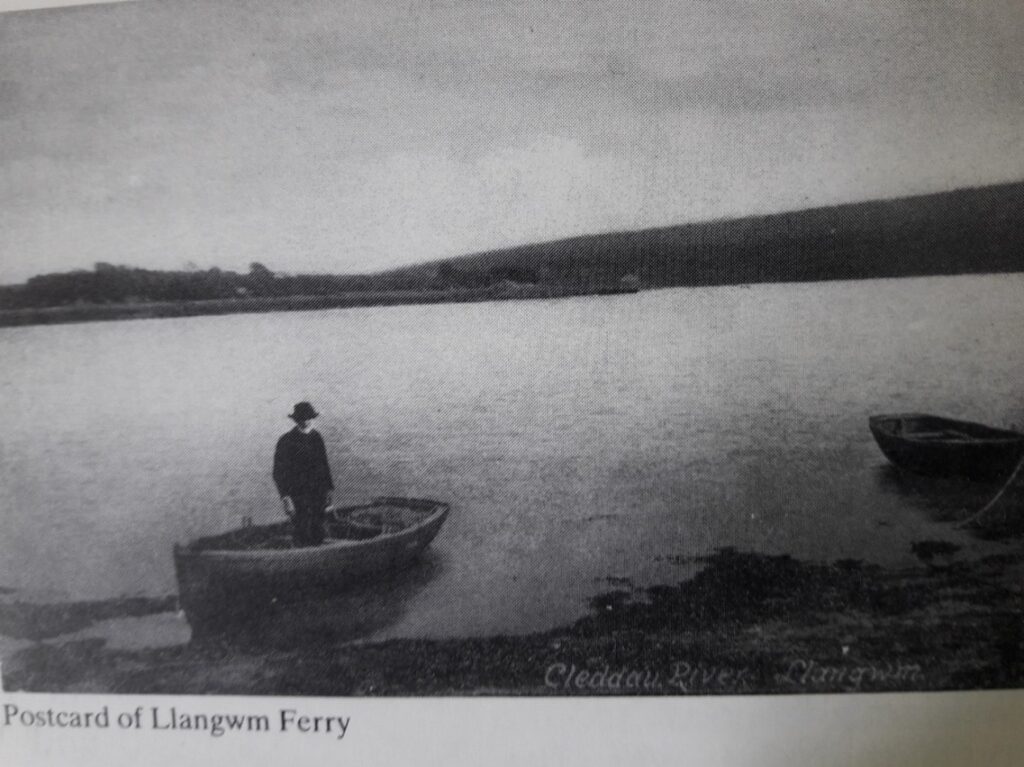
A boatman on the Llangwm Ferry shore. Is this William Pickens? Or perhaps Old Dulph?

One of the boats used as the ferry from the Llangwm side. Similar in design to the traditional Llangwm fishing boat, this boat seems rather larger. Photo courtesy of Graham Stephens. Graham Stephens. The Traditional Llangwm (Fishing) Boat. http://www.llangwm-pembrokeshire.org.uk/llangwm_bygonedays.html
Grenville Thomas records that William Pickens died of cholera in an outbreak in January 1867.[15] It is unclear whether his death was related to the three deaths from cholera of a fisherman, his wife and son, who died at Langum Ferry, in September, 1866.[16] These cholera deaths must have been unexpected, as reports of the cholera epidemic in Pembrokeshire described Langum as ‘in a perfect state of cleanliness… [and] a model of cleanliness”[17]
Pickens’ immediate successor is not clear, but by 1901 the ferryman was William Adulph. Captain William Adulph, known as “Old Dulph” (to distinguish him from his son, also William), was of Norwegian extraction, though born in Llangwm in 1835.[18]
According to Grenville Thomas, Old Dulph had owned a schooner. He died in 1917, aged 78, his obituary appearing in the Haverfordwest and Milford Haven Telegraph of October 31st.. The obituary, written by his friend the local Baptist minister Rev W. Davies, is disappointingly short on facts, but records his strong spiritual and even mystical commitments. Like his predecessor, William Pickens, Old Dulph had been a stalwart and deacon of the local Baptist chapel. Although Adulph’s name does not appear in the census records for Llangwm Ferry, he does appear in the 1871 census as a “Mariner”, living in nearby Guildford with his wife Sarah, and five children. This suggests that intending passengers needed to arrange the ferry passage in advance, a view supported by H.J. Dickman.[19] However, Grenville Thomas suggests that the young boys living at Llangwm Ferry also took on the ferry duties from time to time on behalf of Old Dulph.
Thomas also relates that Old Dulph’s ferry was often used by the Squire of Lawrenny and Lady Maude Lort Phillips on their visits to Llangwm (where they owned many of the houses up until 1911-12). Since it would surely have been more convenient for them to have used a ferry starting from the Coedcanlas side, this may be a further indication that the Coedcanlas ferry had stopped running by the turn of the century. By 1912, William Llewellyn, known as “Darkie”, who lived in Rosedale, Llangwm Ferry ran the ferry. “Darkie” was the last of the Llangwm Ferry ferrymen, operating the ferry until the 1930s. He had previously been a shipwright in the Pembroke Dockyard, and, presumably, his role as ferryman really dated from the Dockyard’s closure in 1926. It is possible, then, that prior to 1926, Darkie shared his ferry responsibilities. This would be compatible with a report that Edward Morgan, operated the ferry around this time.[20] Interestingly, Edward Morgan was probably the grandson of William Pickens.
End of the Ferry
With horse traffic in terminal decline, the local ferries were becoming obsolete. From the 1920s passage across the Haven by motor vehicles was enabled by the ferries running from Hobbs Point to Neyland. What remains to mark the previous ferry are two hamlets, Llangwm Ferry on the western shore, and a few houses near the beach at Coedcanlas (fig 4). Over the previous two centuries the two communities had been closely bound up with each other. The 19th century Llangwm fisherwomen on their way to Narberth or Tenby to sell their fish would have used the Coedcanlas landing point (though as proficient boat people themselves, they had no need of the ferry itself). The Skyrmes at Coedcanlas were a Llangwm family. Even at the end of the 1st World War, my great-great grandfather, George Stephens, living on the Llangwm side, noted in his diary for 16th October, 1918, that he had been digging out potatoes over at Coedcanlas. Nowadays, there is no contact between the cross-river neighbours. On the Llangwm side, all that remains is the ruin of the ferryman’s cottage above the beach by the footpath leading up through Benton Wood, and the name, Llangwm Ferry.

The Ferry House at Coedcanlas from Llangwm Ferry, 2019.
Notes
1. Certificate of redemption by John Colby, esq., receiver of the estates of Sir Hugh Owen, Bart, of the land tax …, 1799, June 21. 993. Records held at the National Library of Wales.
2. In fact, the Owens had acquired Coedcanlas at some time during the Civil War when their predecessors, the Butlers, who were ardent Royalists, were dispossessed (Richard Fenton: A Historical tour through Pembrokeshire, 2nd edition, p.136). Since both the Butler family and their successors, the Owens, also owned estates in Johnston, one might speculate that an important reason for the ferry was to allow easy communication between the two estates. Hence the clause in the 5th January, 1759, lease that the estate’s servants “Shall have full and free Liberty with Horse and Horses to pass and Repass the Ferry known by the name of Langum Ferry in the Ferry Boat free and clear of toll Charges whatsoever”.
3. Keith Johnson. The Pubs of Narberth, Saundersfoot and South-East Pembrokeshire, 2004. Logaston Press, Woonton Abbey.
4. In the 1780s and 1790s the Rev Dr Philipps was a zealous magistrate at the Pembrokeshire quarter sessions, and by 1801, was the chairman of the quarter sessions. Philipps had been rector at Talbenny, 1759-80, and of Walwyn’s Castle 1760-1815. At the time he was also the vicar of Burton.
5. Records held at the National Library of Wales under “Ffynone Estate Records” (entry 892-3) refer to a “List of passengers who crossed Langum Ferry in Dr Philipps’s boats”, while a year later (entry 1923, May 5th, 1800) indexes “Opinion by Thomas Miller of Lincoln’s Inn concerning the ferry service across the river Cleddy from a point on Coedcanlas”. See Note 1
6. An 1802 document from the Colby Estate papers refers to the payment of £13-15-3d to Thomas Canton, ships carpenter, for repairs to the Llangwm and Landshipping Ferry boats belonging to the Orielton estate. R..Ll. Davies and J. Nelson. A River Never Sleeps. Newport. 1999 (page 57). These boats were presumably built at the Landshipping boatyard.
7. Hugh Barlow failed in his attempts to obtain the County seat for his nephew, but Sir Hugh Owen did succeed to the Pembroke Borough seat on his uncle, Hugh Barlow’s death, 23 Jan. 1809. Despite his apparent political differences with the Orielton family, Hugh Barlow bequeathed part of his own estate to the heir to the baronetcy. At the time this was his nephew, Sir Hugh Owen. However, Sir Hugh Owen himself died 8 Aug. 1809, without often attending Parliament. By a will dated 2 Aug, alleged by its critics to be forged, he disinherited his next of kin and left his estates to a more distant kinsman, John Lord, who adopted the name John Owen. John Owen subsequently represented first Pembroke Borough (1809) and later (1812) the County, as a Tory. John Lord married Charlotte, daughter of Rev John Lewes Philipps of Llwyncrwn, Llangynin, Carm., in December, 1800 (not to be confused with Rev Dr John Philipps of Williamston).
8. R. Lockley. Orielton: The human and natural history of a Welsh manor. Penguin books, Harmondsworth. 1977.
9. John Burke. A Genealogical and Heraldic Dictionary of the Landed Gentry of Great Britain.
10. Richard G. Thorne. The Pembrokeshire elections of 1807 and 1812. The Pembrokeshire Historian, Vol 6. (1979)
11. It is not clear whether the Rev Dr John Philipps was himself related to the Picton family. One account (http://orapweb.rcahms.gov.uk/coflein/P/PHGS_193.pdf) claims the family had changed the spelling of their name to use the double p associated with the Picton family for social reasons. Further, the political stance of Rev Dr John Philipps himself is not known. His son, John Henry Philipps (1808-76) of Williamston, assumed the name and arms of the Scourfield dynasty when he inherited the estates of his uncle, William Henry Scourfield. Since William Henry Scourfield was a Whig MP who had represented Haverfordwest Boroughs 1852-68 (and was created a baronet shortly before his death in 1876), and political allegiance was often a family affair, we may hazard that the previously Philipps family was also Whig.
https://www.historyofparliamentonline.org/volume/1820-1832/member/scourfield-william-1776-1843
12. R.Ll. Davies and J. Nelson. A River Never Sleeps. Newport. 1999
13. https://www.skyrme.info/library/skyrme_pemb2.pdf
14. Francis, Dick. The Sport of Queens: An Autobiography.
https://books.google.co.uk/books?id=fcKLToFTJRYC&pg=PT14&lpg=PT14&dq=Dick+Francis+coedcanlas&source=bl&ots=tbGssiuSkv&sig=ACfU3U2bvQOiiT8vBdv28EVTSg_kY4T_EA&hl=en&sa=X&ved=2ahUKEwjepa_zz43qAhVOURUIHTdMDZsQ6AEwDHoECAwQAQ#v=onepage&q=Dick%20Francis%20coedcanlas&f=false
15. Thomas W.G.. The People of the Covenant. Haverfordwest, 1988
16. “The Report of the Cholera Epidemic” reported to Parliament as a supplementary to the Annual Report of the Registrar for Births Deaths and Marriages of England (Vol 29, in paragraph 591).
17. Carmarthen Journal, August 31, 1866
18. Old Dulph was the son of Peter Adulph and his wife, Dorothy. Following Peter’s death at age 26, Dorothy remarried for a second time. In 1839 she had an illegitimate child before marrying George Llewelyn in 1842. It is of some interest that George and Dorothy were the parents of Dolly Palmer who acquired fame in the national press as the archetypal Llangwm fisherwoman. Her image appeared on postcards, teacups and chocolate boxes. Old Dulph therefore seems to have been half-brother to Dolly. See also Jane Smallfield, Descended from Dolly the Bridge. Pembrokeshire Life, December, 2012.
19. H. J. Dickman. Burton Parish, Pembrokeshire. Dyfed County Council, undated. Page 34
20. Sue Fletcher. Personal Communication. Edward Morgan also owned a dredger and was contracted to the railways to deep dredge the channels to Pembroke Dock for the movement of coal.
Acknowledgements
Thanks to my brother, Graham Stephens, for proof reading, corrections and suggestions.
The Llangwm Local History Society kindly allowed me to use a photo (fig 3) from their collection.
Thanks to Robert Ll Davies for permission to use the photograph of the Ferry House, Coedcanlas.
The National Library of Wales, Aberystwyth, sourced documents relating to the dispute over ferry rights at the turn of the nineteenth century, while the Pembrokeshire Record Office, Haverfordwest, was a valuable source of material, which the efficient, friendly and knowledgeable staff helped me track down.
Lastly, at my home institution, the University of Sussex Library facilitated access to documents that I had had difficulty in obtaining, especially publications in Victorian learned journals.