
The PAXS Coins of Wales
By Bob Joyce (updated)
Although Wales did not have a monetized economy until the Norman occupation of south Wales in the early twelfth century, a number of late eleventh century Norman coins have been ascribed to St Davids, Cardiff and Rhuddlan. While it has been suggested that the former were produced by King Rhys ap Tewdwr to pay the render for his tenure of south Wales to the English crown, and the latter by Earl Hugh of Chester and Robert of Rhuddlan in the development of north Wales, there has been little additional speculation. This article uses coin details to propose a wider context for their manufacture, identifies specimens held in various museums, lists their published images and provides photographs of the omitted examples.
There has been some debate as to the dating of the silver ‘PAXS’ type penny, so called from the letters arranged around a central cross. Various authorities suggest that it was the last to be struck in the reign of William I (1066-1087), while others propose that it was the first to be produced by his son, William Rufus (1087-1100). The latter point out that since ‘PACX’ was used on the accession coinage of Edward the Confessor (1042-1066), and ‘PAX’ on Harold II’s (1066), it is likely that the term was employed for Rufus’.[1] However, since the PAXS type was the first to have a higher weight across all the mints of England, such an introduction would have been unpopular as people would have received fewer pennies in the re-coinage and hazardous since Rufus’ hold on the throne was insecure, with many of the English nobles preferring his brother, Robert Curthose, Duke of Normandy, as king. It is more likely that the national measure was initiated by his father during the Danish invasion threat of 1085 in order to attract mercenaries from the continent and enable their deployment across the kingdom. The word PAXS may, therefore, be seen as a reminder to the population of the peace enjoyed during his reign,[2] in contrast to the potential chaos that could result from English support for the Danish forces.
The crisis was caused by King Cnut who sought to regain the English throne with the help of Count Robert of Flanders. A Danish fleet was assembled at Limfjord in northern Jutland with the aim of sailing to Flanders and then across to the coasts of England. To face this threat William organised watches to monitor the coasts, port officials to control shipping, and the withdrawal of stock and crops from seaboard districts to prevent their use by invaders.[3] In order to increase his military forces, William recruited large numbers of mercenaries from France, Brittany and Maine. They arrived in the autumn and were deployed throughout England, their pay being provided by the king and the cost of billeting borne by towns, barons, abbeys and other lords.[4] This dispersal enabled the kingdom to support larger numbers while also preventing the prospect of an English revolt. The uniform weight of the coins ensured that the various contingents received the same amount of silver wherever they were posted.
The existence of coins apparently struck at Cardiff, St Davids and Rhuddlan suggests that troops were also deployed in south Wales in the territory of King Rhys ap Tewdwr, as client-ruler for William I,[5] in north Wales on that of Earl Hugh of Chester and Robert of Rhuddlan, and in mid-Wales on that of Earl Roger de Montgomery.[6] This increased the total force and helped maintain stability in Wales and the borderlands. Thanks to the good relations between William I and Turlough O’ Brien, king of Munster and high-king of Ireland (with opposition), who controlled the Hiberno-Scandinavian towns, any outside support for a Welsh insurgency was precluded.[7] Mercenary detachments could have been stationed on one of the demesne lands in each cantref,[8] while the other commotes supplied provisions; alternatively, troops may have been deployed in camps near the coasts for ease of supply and logistics, the estuaries of Milford Haven, the Taff, Clwyd and Conwy being suitable for such purposes, the last two having established strongholds at Rhuddlan and Degannwy respectively. Although there is a fort between St Davids and the sea, this is believed to have been constructed for Bernard, the first Norman bishop, who was appointed in 1115. The fort at Cardiff may have been built in 1081 in support of William I’s assertion of overlordship after Rhys gained control of south Wales following the Battle of Mynydd Carn.[9] The town was recorded as having been founded at that date[10] and the stronghold could have been re-occupied during the emergency, causing a further expansion of the settlement. There are no documentary records of the mercenary forces in Wales during this period as the entries in the Brut y Twysogyon and the Annales Cambriae are brief and lack detail: the Battle of Mynydd Carn and the visit of William I to St Davids (1081), the dating of the nineteen year Easter cycle (1082), the resignation of Sulien, bishop of St Davids (1085), the deaths of Turlough O’ Brien (1086) and William I (1087) are mentioned[11] but the large army and fleet[12] that probably accompanied William during his advance through south Wales are not noted at all.
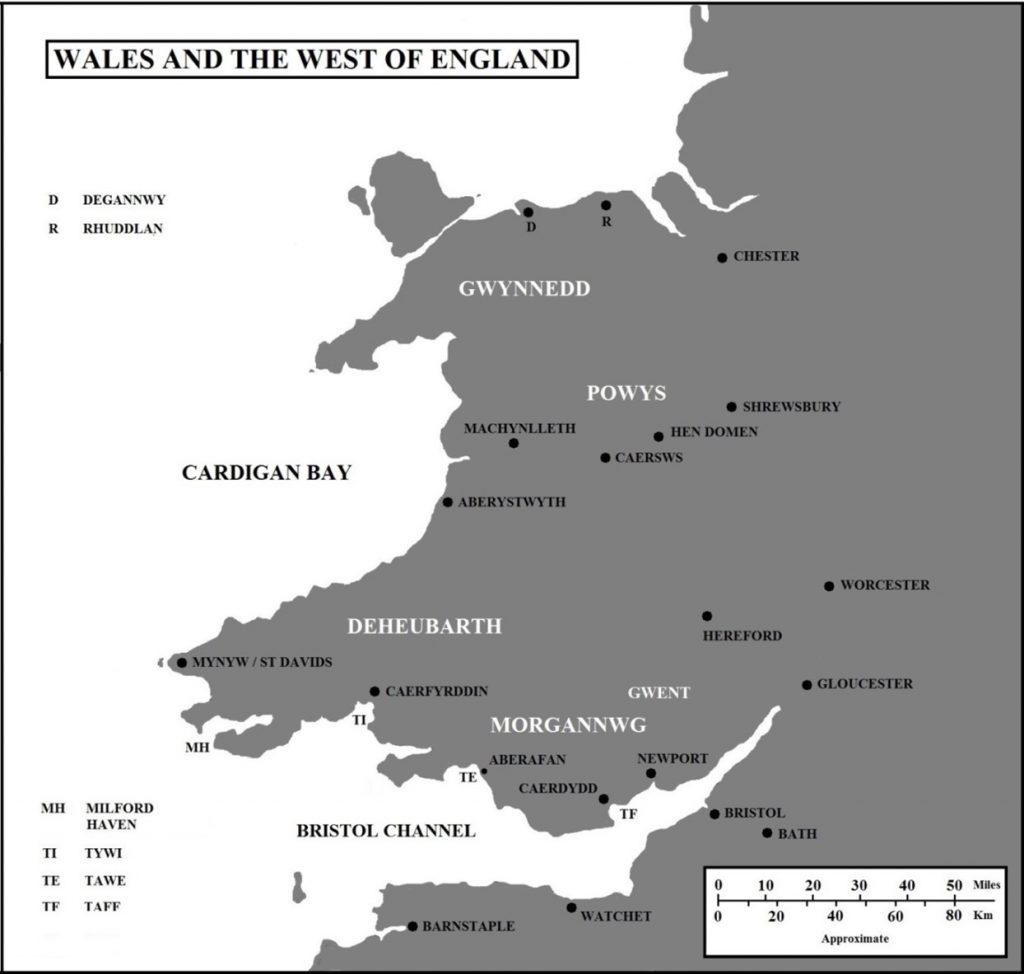
To supply the mercenary pay, moneyers would have been needed to establish mints and organise production in Wales. Moneyers in England were men of some wealth and position who would oversee the manufacture of coins while employing others to perform the work. Their stamping irons, called dies, were made at official workshops in London so that the designs and lettering were uniform across the country. The styles, called types, were changed every two or three years in a re-coinage which reduced fraud and increased state revenue; the moneyer going to London to collect and pay for his new dies. However, those used in Wales were locally produced, having a lower standard of workmanship with variations in lettering and detail, all indicative of an emergency situation.[13] Some of the coins were mis-struck, making interpretation of the letters difficult, but generally they contained good percentages of silver.[14]
It is possible that initially the moneyers were official operators from the border towns[15] since the men of Hereford and Shrewsbury were obliged to serve in the king’s army in Wales.[16] Some limited evidence for this is that an irregular coin of Shrewsbury, struck by one of its moneyers, Godesbrand, is similar in appearance to the Welsh specimens. It is closely related to an example from St Davids struck by ‘Turri’ which has the same obverse (portrait side) and with the Paxs letters on the other (reverse side) unusually connected to the inner circle by short links.[17] It is feasible that Godesbrand’s dies were used at Earl Roger’s fort of Hen Domen near Caersws and then at St Davids with the Shrewsbury identification retained to validate the coins. Subsequently Godesbrand could have returned to Shrewsbury but with the obverse retained at St Davids by Turri.
At Chester, an irregular reverse of ‘Unnulf’ may have been struck by the official moneyer Sunoulf since the two have an identical official obverse but the former’s reverse is remarkable in that it represents the city by the administrative form ‘Cestre’ which appears in the Domesday Book of 1086, rather than the usual ‘Legestre’ or ‘Lehecestre’. It is possible that Sunoulf was responsible for the initial Rhuddlan coins but altered his name to Unnulf, and used Cestre to avoid confusion between the two versions.[18] At Cardiff, the unknown Ae(lf)wi Turi appears on one coin but the double name is very unusual and likely to indicate two individuals working in association rather than a single person, the first perhaps being Aelfwi of Hereford.[19] Since ‘Turri’ is also found at St Davids it is possible that the double form was used to publicise his presence in the Bristol Channel area. Other operators appearing on coins are Aelfsi and Swien at Cardiff; Ifliwine and other unidentified individuals at St Davids; [—]ivan, and Aelfwine at Rhuddlan.[20] Aelfsi could be the Chester moneyer but in view of the distance it is more likely that he was a merchant from the border appointed as a replacement overseer. Swien might be Swein from nearby Bristol[21] while the later Aelfwine of Chester is a possibility for Rhuddlan.[22] It is unknown whether the moneyers at the various sites operated at the same time or consecutively but the usual period for military tenants was 40 days in peace and 2 months in war.
Coins of the period were produced by placing a disc of silver alloy between the dies, the mounted obverse (lower) having the more intricate king’s portrait and name, while the hand-held reverse (upper) bore a geometric design with the moneyer’s name and place of minting. The obverse legend, ‘King William’, was written in variations of PILLELM REX where the Anglo-Saxon letter P (wen) represents the consonant W;[23] the legend is read clockwise from the bottom left, while that on the reverse starts at the top, first with the moneyer’s name, followed by ON (i.e., at), and then the site; all can be truncated depending on the amount of space or the preference of the engraver/sinker (see Figure 2). The reverse of the Paxs type bore a cross dividing the coin into quarters, enabling it to be cut into four pieces for small change, with one PπXS letter in each quadrant. (π has been used as the closest representation of the Anglo-Saxon letter.)
There appear to be three groups among the coins: (a) with meaningful legends on both sides; (b) with an intelligible legend only on the reverse; (c) with incomprehensible strings of letters on both sides. The reverse dies use vernacular letters such as π and V rather than the current official II for both A and V, and the earlier /E for the official IE.[24] It is proposed that the first group was struck for the mercenaries in north and south Wales, with Rhuddlan rendered as RVDILI, Cardiff as CπIRDII and CARITI (possibly for Caer Taff), St Davids as DEVITVN (Dewi’s Tun) and RMI[25] (perhaps the bishop’s estate on Ramsey island).[26] Aelfwine’s Rhuddlan and Turri’s Devitvn obverses are all different in small details while their respective reverses appear to be identical. This suggests that the latter were mounted in the heavy wooden block which supported the lower die, to prevent theft and counterfeiting. Although irregular in appearance and detail it is likely that the money was accepted in England, unlike the lighter Hiberno-Scandinavian coins circulating in the western seas, which had to be exchanged at mints in ports such as Bristol, Watchet and Barnstaple. These were lighter, less well executed and bore token representations of legends.[27]
Actual diameter of coins approximately 20 mm.
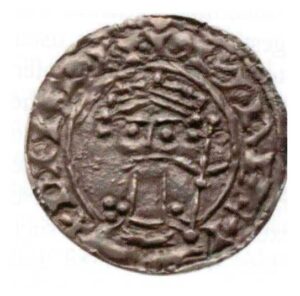
+PILLNEMRE+I

+T(II)RRI ON DEVITVN
Figure 2 BMC 585 duplicate
Images courtesy of The Ashmolean Museum, Oxford
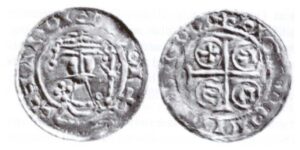
Figure 3 BMC889/890 variant: BM1985 7-82-31
Images copywright of The Trustees of the British Museum
+IOI[–]FIIIIE+ +(F)IO[-]IIIOIII[–]IIIIII
The mercenaries in England and Wales stayed until the onset of winter when it was learned that the invasion had been postponed following large-scale desertions from the Danish fleet. William retained some of the troops but it is not known whether these were only in eastern England or across the country. The following year Cnut attempted to assemble another navy but the fines imposed on those who had deserted resulted in rebellions and ultimately led to his murder at Odense in July 1086. Once the mercenary pay was suspended it is likely that the Rhuddlan mint continued striking for Earl Hugh and Robert, for their privilege is recorded in the Domesday Book.[28] New official dies would have been supplied from London but to date only coins bearing the emergency legends have been discovered, possibly due to the chances of survival, reduced trade or closure of the mint.
The other two groups were produced only in south Wales, some less well executed and with the Paxs letters having irregular orientations due to inexperience or higher standards no longer being necessary (see Figure 3 where the obverse legend has been rendered backwards [retrograde] and with inverted lettering). It is proposed that these coins were struck by King Rhys ap Tewdwr who had taken over the mints to furnish the tribute for south Wales in cash rather than by the sale of cattle and horses,[29] or supplying silver bullion and mixed coin; Rhys could now deliver the levy without any disagreements over the value of livestock or bullion. The render amounted to £40 per annum, equivalent to 9,600 pennies, but it is possible that others were struck to purchase domestic luxuries from traders and as bullion gifts to Welsh tribal leaders.[30] It is feasible that the ‘clas’ at St Davids and Llandaff had some role in the production, record-keeping and security of the coinage.[31]
Since ‘foreign’ coin was not permitted to circulate in England, it is likely that the absence of William’s name on these coins was intended to prevent their use in England while the remaining portrait and legends displayed Rhys’ kingship to his subjects and traders. None of the coins have yet been found in Ireland since their weight and silver content were on a par with the official English pennies and, like them, were probably melted down to produce the lighter Hiberno-Scandinavian money.[32]
Group (b) has intelligible legends only on the reverse, but it is uncertain whether the ‘English’ moneyers identified supervised operations or their names were inexpertly suggested by native operators as a matter of form. One specimen appears to have been struck by Turri at St Davids, but his name is poorly executed, the king’s bust is reversed and both sides have retrograde lettering.[33] Another, by Swien at Cardiff, has the S obscured, while the letters for the town, rendered as CIVRDI, may overlay those of Bristol; it has been suggested that Swein of Bristol allowed a reverse die to be modified and sent to Cardiff.[34] A third example was produced by Ifliwine, perhaps Lifwine of Bristol, which has the reverse retrograde and the letters inverted [35] The site is identified as FIINI for FVNI or FANI, the latter proposed as referring to Y Fani, the Welsh name for Abergavenny, but the term is a late medieval contraction to Y ‘venny’; Fvni arguably represents the Welsh name for St Davids – Mynwy which mutates to Fynwy after the preposition ON,[36] becoming FVNVV and then shortening to FIINI with the more recent II for the initial V.
Group (c) has meaningless strings of letters on both sides which mostly employ I, O and N’s; the obverse legends are similar, retrograde and inverted, but with a cross-pommée on the king’s right shoulder; the reverses are all different. This may indicate that suggestion of words was now acceptable, similar to the practise of the Hiberno-Scandinavian moneyers, while the cross could represent the ecclesiastical site of St Davids. There are no examples of this group from Cardiff, either due to production being concentrated in Dyfed or the lack of discovery.
Most of the surviving specimens have come from the Beauworth hoard, possibly hidden during the barons’ revolt against William II in 1088. It was discovered in Hampshire in 1833 and has been associated with payments from the Winchester treasury.[37] In 1933 another FIINI example was found at St Davids during excavations within the cathedral precincts[38] while in 2002 a fragmented DEVITVN coin was recovered near Port Talbot on Aberafan beach.[39] In the nineteenth century or before, a Rhuddlan specimen by Aelfwine, with another obverse, was discovered in Sweden.[40]
The south Walian (b) and (c) coins were probably produced in 1086 and 1087 with those in the Beauworth hoard escaping immolation for use in treasury payments shortly before the next re-coinage. The render could have ceased after William II’s accession in September 1087 if the client status had been revoked or following Rhys ap Tewdwr’s temporary ejection by the Powysian dynasty in 1088, possibly during the barons’ revolt from April to July. Although Rhys regained power by fleeing to Ireland, hiring a Hiberno-Scandinavian fleet and returning to defeat his opponents, his position was probably regarded as insecure by Rufus with south Wales a potential opportunity for annexation.[41] Following the termination of the render coin production probably ceased with gifts and purchases reverting to earlier forms. It is uncertain when William II’s first Type was produced, either following his coronation or after he had crushed the rebellions and firmly established his rule but the bellicose figure[42] on the obverse suggests the latter date. Rhys managed to maintain his position in south Wales for several more years but without the support of the English king his hold became increasingly precarious. In 1091 he had to suppress a revolt by the leading dynasty in Dyfed and the Marcher lords were advancing further into Brycheiniog,[43] the latter encroachment ultimately leading to his death near Brecon in 1093. Rhys ap Tewdwr has been recognised as an important ruler of south Wales and, if the foregoing narrative is accepted, he can also be credited with the production of a transient, partial, indigenous coinage.
SUMMARY
The PAXS type was introduced by William I in 1085 with an increased weight across all the mints of England in order to attract and pay large numbers of mercenaries from the continent and defend the country against a threatened invasion by King Cnut of Denmark. The military force was deployed across England and billeted on William’s tenants. Other contingents were sent to Wales and supported on the lands of King Rhys ap Tewdwr, Earl Hugh of Chester, Robert of Rhuddlan and Earl Roger de Montgomery with mints being established at Cardiff, St Davids and Rhuddlan. Following the end of the crisis and the departure of the mercenaries, the Rhuddlan mint continued under the Norman lords but no further types have yet come to light. In south Wales King Rhys started to produce his own coins which bore incomprehensible legends in order to prevent their use in England. These enabled him to pay the render for the client rule of south Wales in cash rather than kind, to award the Welsh nobility with bullion gifts in coin, and to purchase domestic goods from traders. After the accession of William II, the Paxs Type was replaced in 1088; with the removal of client status, the render ceased and south Walian production of coin probably ended.
SPECIMENS AND LOCATIONS
The BMC and BM accession numbers are from the British Museum Catalogue of 1915 or later, other references are from the respective museum catalogues. The preceding superscript a b c indicates the author’s suggested coin group; those with an asterisk * have photos in the BMC, those with endnotes have images elsewhere, while those without are shown here.
BRITISH MUSEUM, LONDON
Chester/‘Rhuddlan’ a BMC 598 Unnulf *
Rhuddlan a BMC 869 Ælfwine * a BMC 870 Ælfwine [1] a BM 1985 7-82-43 [—]ivan
Cardiff a BMC 582 Ælfsi * b BMC 583 Spien * a BMC 584 Æ(lf)wi Turi *
Shrewsbury/‘St Davids’ a BMC 938 Godesbrand *
St Davids a BMC 883* a BMC 884 a BMC 885 * a BMC 886 all Turri; b BMC 887 Turri* b BMC 888 Iflipine* c BMC 889 c BMC 890 c BMC 889/890 variant: BM 1985 7-82-31
NATIONAL MUSEUM OF WALES, CARDIFF
Rhuddlan a 55.361/2 [2] Ælfwine
St Davids a BMC 884 duplicates: 55.361/3 [3] 58.526/1 [4] both Turri
b BMC ‘887’ fragments: 2004.37H [5]
b BMC 888 duplicates: 55.361/4 [6] 70.42H/3 [7] both Iflipine
c BMC 889/890 variant: 90.112H [8]
FITZWILLIAM MUSEUM, CAMBRIDGE [9]
Cardiff b BMC 583 duplicate: CM.862-2001 Spien
St Davids a BMC 884 duplicate: CM.889-2001 Turri
b BMC 888 duplicate: CM.850-2001 Iflipine
c BMC 889/890 variant: CM.851-2001
ASHMOLEAN MUSEUM, OXFORD
St Davids a BMC 885 duplicate [10] Turri
NOTTINGHAM MUSEUM AND GALLERIES, NOTTINGHAM
St Davids b BMC 888 duplicate: NCH 1885-19 [11] Iflipine
STOCKHOLM
a Rhuddlan [12] Ælfwine
TOTALS
Of the 31 coins held by various museums, there exist 6 distinct varieties for Rhuddlan, 3 for Cardiff and 13 for St Davids; there are no duplicates for Rhuddlan, 1 for Cardiff and 8 for St Davids. Group (a) contains a total of 17 specimens: all of the 6 from Rhuddlan, 2 from Cardiff and 9 from St Davids (4 duplicates); Group (b) totals 9: the 2 from Cardiff (1 duplicate) and 7 from St Davids (4 duplicates); Group (c) contains 5, all from St Davids, with no duplicates.
There are also 5 unlocated specimens, apparently duplicates of BMC 885, 888, 888, 889 and 938, that were sold at auction or otherwise over the last century, which are probably in private collections.
ACTUAL DIAMETER OF THE COINS APPROX. 20 MM.
Figure 4. Images © The Trustees of the British Museum
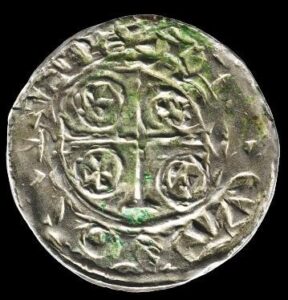

BM1985 7-82-43 RHUDDLAN
Figure 5 Images © The Trustees of the British Museum

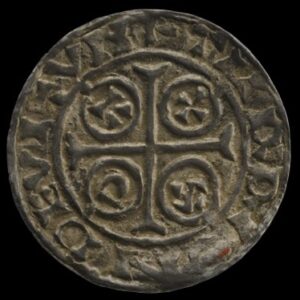
BMC 884 DEVITUN
Figure 6 Images © The Trustees of the British Museum
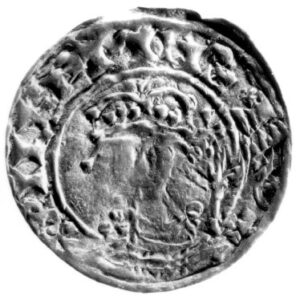
BMC 886
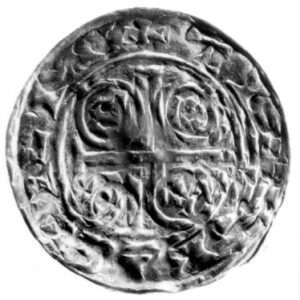
RAMSAY?
Figure 7 Images © The Trustees of the British Museum
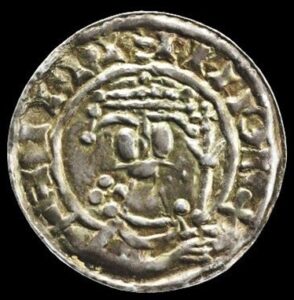
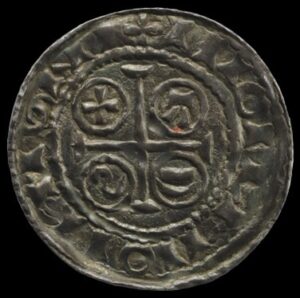
BMC 889 ST DAVIDS
Figure 8 Images © The Trustees of the British Museum

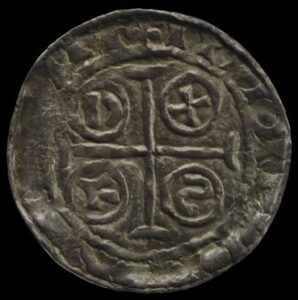
BMC 890 ST DAVIDS
ABBREVIATIONS
BM Recent British Museum catalogue number
BMC British Museum Catalogue:
Vol. I: (https://archive.org/stream/catalogueofengli01brituoft) for text and images of coins.
Vol. II: (https://archive.org/stream/catalogueofengli02brituoft) for older numbers, and legends.
BNJ British Numismatic Journal: http://britnumsoc.org:
► Publications ► By Year ► Year ►Article
EMC Early Medieval Corpus of Coin Finds: (https://emc.fitzmuseum.cam.ac.uk):
► Advanced search ► enter EMC/SCBI number ► Search
FM Fitzwilliam Museum: (https://collection.beta.fitz.ms): enter accession number in ‘Search our site’ ►select first example (website in development)
SCBI Sylloge of the Coins of the British Isles
ACKNOWLEDGEMENTS
Thanks are due to Martin Allen, Editor of the BNJ, and associates for advice, alternative suggestions and additional references, although the author is responsible for the views expressed; to Martin in his role as Senior Assistant Keeper, Department of Coins and Medals, Fitzwilliam Museum, Cambridge for further advice on coin characteristics and the Museum’s collection; to Gareth Williams, Iain Birkett and colleagues at the British Museum; Edward Besly, National Museum of Wales, Cardiff; Julian Baker, Ashmolean Museum, Oxford; Ann Inscker, Eillean Patrick and colleagues, Nottingham Museums and Galleries, for their kind assistance and facilities while examining their collections; to Ruth Willats and Peter Tyson for reading various drafts and recommending improvements. The author is responsible for any errors or omissions but would welcome any corrections or further information on the present whereabouts of various coins.
NOTES
- [1] M. Allen, Coinage and Currency under William I and William II, in R. Naismith, M. Allen and E. Screen (eds), Early Medieval Monetary History: Studies in Memory of Mark Blackburn (Farnham 2014), 90-4.
[2] P. Nightingale, English Medieval Weight-Standards Revisited, in British Numismatic Journal [hereafter BNJ] 78 (2008), 179-80.
[3] F. Stenton, The First Century of English Feudalism (2nd ed., Oxford 1961), 149-51; M. Swanton (ed. and trans.), The Anglo-Saxon Chronicles (2nd edn, revised paperback, London 2001), 215-16; J.R. Maddicott, Responses to the Threat of Invasion 1085, in English Historical Review, CXXII (September 2007), 986-97.
[4] P. McGurk, (ed. and trans.), The Chronicle of John of Worcester, (3 vols., Oxford 1998), III, 42-3; M. Winterbottom and R.M. Thomson (eds), William of Malmesbury: Saints’ Lives (Oxford 2002), 130-1.
[5] R.S. Babcock, Rhys ap Tewdwr, King of Deheubarth, in Anglo-Norman Studies XVI (1993), 21-7.
[6] W. Rees, An Historical Atlas of Wales, from Early to Modern Times (2nd edn., reprint, London 1966): for King Rhys see pl.28 (south Wales), for the Normans see pl.29.
[7] M.T. Flanagan, Irish Society, Anglo-Norman Settlers and Angevin Kingship (Oxford 1989), 13-21; B. Hudson, William the Conqueror and Ireland, in Irish Historical Studies Vol. XXIX, No. 114 (November 1994), 145-58; M.A. Valante, The Vikings in Ireland (Dublin 2008), 154-60; J.O. Prestwich, The Place of War in English History, 1066-1214 (Woodbridge 2004), 27-30.
[8] W. Rees, op. cit., 24-5 and pl.28; W. Davies, Wales in the Early Middle Ages (Leicester 1982), 43-7.
[9] R.S. Babcorck, op. cit.24-7; R. Turvey, The Welsh Princes 1063-1283 (Harlow 2002), 68-70.
[10] P. Courtney, The First Welsh Mints and the Origins of Cardiff, in Morgannwg XXX (1986), 65-9.
[11] Revd, J. Williams ab Ithel (ed.), Annales Cambriae, Rolls Series 20 (London 1860), 27-8; T. Jones, Brut Y Tywysogyon or The Chronicle of the Princes, Peniarth MS. 20 Version, Board of Celtic Studies, University of Wales, History and Law Series, No. XI (Cardiff 1952), 17-18.
[12] D.C. Douglas, William the Conqueror, (2nd edn. reprint, London 1990), 225-7.
[13] G.C. Boon, Welsh Hoards 1979-1981 (Cardiff 1986), 49-50, 53 for a twelfth-century example.
[14] M. Dolley, The Norman Conquest and the English Coinage (London 1966), 33.
[15] For their known operational periods in the two reigns, see M. Allen, The Mints and Moneyers of England and Wales, 1066-1158, BNJ 82 (2012), Appendix: 68-71, 73-4, 79-80.
[16] F. and C. Thorn, Domesday Book 17: Herefordshire (Chichester 1983), fol. 179 a: C8, 9, 10 for Hereford; F. and C. Thorn, Domesday Book 25: Shropshire (Chichester 1986), fol. 252a: C4 and note for Shrewsbury.
[17] G.C. Brooke, A Catalogue of English Coins in the British Museum. The Norman Kings, [hereafter BMC] (2 vols., London 1916), vol. II for legends, Shrewsbury: 174-5, No. 938; St Davids: 165-6, No. 883; for associated photos of coins see vol. I: plate XXIV,12 and XXIII, 13 respectively; P.W.P. Carlyon-Britton, The Saxon, Norman and Plantagenet Coinage of Wales in BNJ 2 (1905), 47-54, Plate, Nos 14-18.
[18] BMC II, Chester: 112-13, No. 598 for legend; BMC I: plate XIX, 6 for photo; P. Morgan, Domesday Book 26: Cheshire (Chichester 1978): C, B, A; BMC I, clxvii.
[19] BMC II, Cardiff: 109-10, No. 584 and note; Hereford: 131-3, No. 701.
[20] BMC II, Rhuddlan: 162; for [—]ivan, see F. Elmore Jones, Thoughts on the Norman Coinage of Wales in the Light of Two Additions to the Series, in BNJ 28 (1955-57), 191-5 and pl.xiv, 19.
[21] BMC II, Bristol: 98-101, No. 532 and No. 533.
[22] M. Allen 2012, op. cit., 71.
[23] BMC I, lxiii.
[24] BMC I, l-lii; lvi; lxii-lxiv, table facing cclvi.
[25] BNJ associate.
[26] J.W. Willis-Bund, (ed. and trans.), ‘The Black Book of St Davids’, Cymmrodorion Record Series 5 (1905), 14-17, 62-3; R.M. Lockley, Pembrokeshire (3rd edn., reprint, London 1977), 79-81.
[27] M. Dolley, The Hiberno-Norse Coins in the British Museum, Sylloge of the Coins of the British Isles 8 [hereafter SCBI] (London 1966), 134-6, see images on pl.VII, Nos 222-6, particularly No. 223; B. Hudson, op. cit., 153-5.
[28] P. Morgan, Domesday Book 26: Cheshire (Chichester 1978), f. 269b: G1.
[29] R.R. Davies, The Age of Conquest, Wales 1063-1415 (paperback edn., Oxford, 1991), 156, 257; T. Jones, op. cit., 30.
[30] W. Davies, op. cit., 47-58.
[31] P. Courtney, op. cit., 67-8.
[32] R. Bartlett, The Making of Europe (London, 1994), 286-8 for display; M. Dolley, SCBI 8, op. cit., 135-6 for melting.
[33] BMC II, No. 887.
[34] BMC II, No. 583 and F. Elmore Jones, op. cit., 194-5.
[35] BMC II, No. 888; Lifwine: BMC Nos 530, 531.
[36] B.G. Charles, The Place-Names of Pembrokeshire (Aberystwyth 1992), Vol. I, 283-5; H.W. Owen and R. Morgan, Dictionary of the Place-Names of Wales (2nd edn., Llandysul 2008), 71-2; Ordnance Survey, Place Names on Maps of Scotland and Wales (2nd edn., reprint, Southampton 1987), 16-17.
[37] W.J. Andrew, Buried Treasure: some Traditions, Records and Facts, in BNJ 1 (1903-4), 26-8; P.W.P. Carlyon-Britton, A Numismatic History of the Reigns of William I and II (1066-1100), Part I, in BNJ 2 (1905), 100-5.
[38] M. Dolley and J.K. Knight, Some Single Finds of Tenth- and Eleventh-century Coins from Wales, in Archaeologia Cambrensis, CXIX (1970), 78 n.27, 79-80.
[39] E. Besly, Few and Far Between: Mints and Coins in Wales to the Middle of the Thirteenth Century, in B. Cook and G. Williams (eds), Coinage and History in the North Sea World, c.500-1250. Essays in Honour of Marion Archibald (Leiden: Brill 2006), 707; Coin Register in BNJ 76, 384, No. 254. It is similar to BMC No. 887. The coin was donated to the National Museum of Wales by Messrs T. Belmont (finder) and N. Oxley.
[40] C.E. Blunt and M. Dolley, University collection, Reading: Anglo-Saxon and Norman coins; Royal Coin Cabinet, Stockholm, Part VI: Anglo-Norman Pennies, SCBI 11 (London 1969), 45-7, No. 111.
[41] F. Barlow, William Rufus (paperback edn., London 1990), 74-85; T. Jones, op. cit., 18; R.S. Babcock, op. cit., 28, 33-5; K. Maund, The Welsh Kings (Stroud 2000), 80.
[42] E. Mason, William II: Rufus, the Red King (Stroud 2005), 51.
[43] R.S. Babcock, op. cit., 27-8, 34-5.
[44] P.W.P. Carlyon-Britton, A Numismatic History of the Reigns of William I and II (1066-1100), Part II, The History of the Mints, in BNJ 4 (1907), pl.viii.2; BMC 869 is pl.viii.1.
[45] F. Elmore Jones, op. cit., pl.xiv, 20.
[46] Lockett sale catalogue, Part I, Glendining Auctioneers, 6 June 1955, Lot 981. Auction sale catalogues can be found in the Coins and Medals Department of the British Museum, in the Sackler Library of the University of Oxford and in the Reference Library of the Fitzwilliam Museum, Cambridge.
[47] Lockett sale catalogue, Part III, Glendining Auctioneers, 4 Nov 1958, Lot 2878.
[48] EMC website, enter EMC/SCBI number: 2006.0160.
[49] Lockett sale catalogue, Part I, Glendining Auctioneers, 6 June 1955, Lot 982.
[50] M. Dolley and J. K. Knight, op. cit., pl.xx, 5.
[51] Auction catalogue, Sale No. 81, Spink Auctioneers, 19 Nov 1990, Lot 100.
[52] For images see the FM website.
[53] Accession number: SCBI 12, no.173; Image in D.M. Metcalf, Ashmolean Museum, Oxford, Part II: English Coins 1066-1279, SCBI 12 (Oxford 1969), No. 173, pl.vii; EMC/SCBI number: 1012.0173.
[54] A.J.H. Gunstone, Ancient British, Anglo-Saxon and Norman Coins in Midland Museums, SCBI 17 (London 1971), No. 565, pl.xxi.
[55] C.E. Blunt and M. Dolley, op. cit., no. 111, pl.v; EMC/SCBI number 1011.0611.