
Lewis Landry (1772-1857): The Voluntary Prisoner
By Simon Hancock
Early nineteenth-century prisons would have housed categories of prisoners other than convicted felons. The prison for the county of Pembroke located in the Cock House (situated between St Mary’s Street and Dark Street) and the gaol for the town and county of Haverfordwest (later situated on St Thomas’ Green) would have also accommodated debtors and various individuals suffering from mental illness or severe learning difficulties. The buildings were far from fit for purpose and the gaoler was usually part-time, and staff such as they were would have lacked any semblance of professionalism even if they were personally compassionate.
The Cock House was an ancient building rented by the county for eight shillings per annum as far back as 1640.[1] The great philanthropist and prison reformer John Howard (1726-90) visited the county gaol in 1774 and his observations were contained in The State of Prisons in England and Wales (1777). He considered the rooms ‘dirty and offensive with small windows. No sewers, no courtyard.’[2] The county magistrates were cognisant of these shortcomings and sought powers to build a new gaol. In 1779 ‘An Act for Building a New Gaol and House of Correction for the County of Pembroke’ conceded how the old gaol was ‘greatly too small, inconvenient, and unsafe, and is situate in a low, unhealthy and confined situation.’[3] The quarter sessions were ordered to treat with Robert Bateman Prust for the absolute purchase of the castle of Haverfordwest.
An agreement was entered with Griffith Watkins of the parish of St Martin and John Webb of the parish of St Thomas, both of Haverfordwest, to complete the buildings by December 1780 at a cost of £1,200. The new prison was built against the south wall of the inner ward of the castle, with cells thirteen feet and six and a half inches wide and windows two and a half feet by one and a half feet. The gaol was housed within the fabric of the thirteenth-century castle and contained cells for felons, debtors and a women’s bridewell. The roof was arched with stone and a lead gutter ran the whole length of the building, stretching some 150 feet. The old Cock House was sold off and was eventually demolished in 1847 for the purposes of road widening.
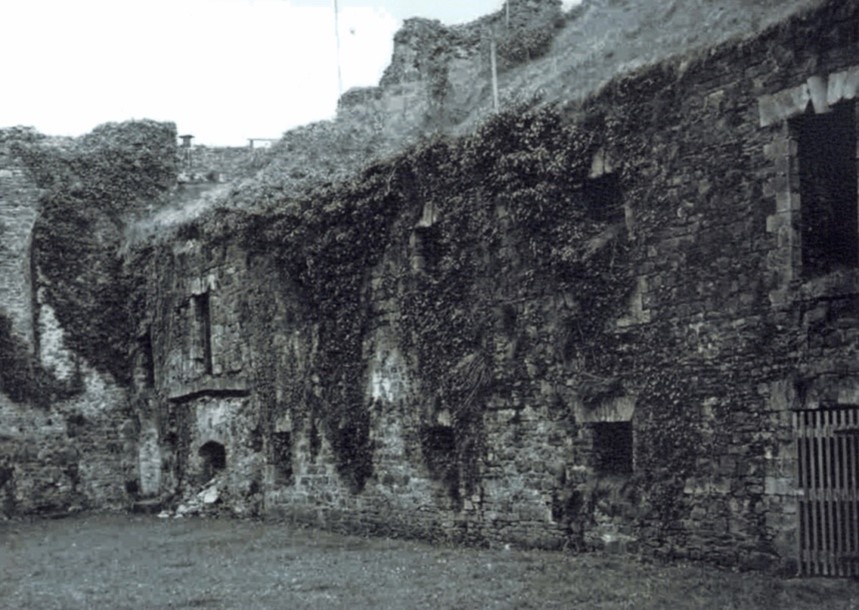
The Georgian prison within the inner ward of Haverfordwest Castle. It was here that Lewis Landry was first imprisoned in 1808.
The improvements in conditions for prisoners were immediately apparent when John Howard paid subsequent visits to Haverfordwest in 1782 and 1788, although they still could hardly be considered comfortable. Felons were compelled to sleep on straw laid on brick floors which were sunk three feet below ground level. Additional buildings were erected within the castle’s inner ward, including a debtor’s prison which was erected between the north tower and the gaoler’s house at a cost of £939 1s. 0d.[4] This was completed by 24 April 1816. Two years later a gaol bakehouse was built adjoining the pine end of the gaoler’s house.[5] Doubtless this baked the bread from flour ground at the treadmill later erected on the site of the old castle chapel. The number of prisoners in the gaol reached a peak of 59 in 1818 although there were 57 in custody when there was a severe outbreak of scarlet fever.[6] No separate building accommodation was ever accorded to lunatics who had not necessarily ever committed any criminal offences. The prison buildings contained two cells for lunatics around the time when another great philanthropist James Neild (1744-1814) visited the prison in 1803.
It was into this suite of rooms within the castle walls that 36-year old Lewis Landry, an agricultural labourer, was committed as a lunatic on 29 October 1808.[7] Nothing is known of his origins or early life. He may have come from Martletwy, although there were Landrys in Slebech, and Lewis may have had a brother George (who died in 1838) and thus a sister-in-law Phoebe Landry who was living at Crafty, Slebech in 1851 and who died in 1855. This unfortunate man suffered some catastrophic breakdown in 1807 and it was because of his raging and unruly behaviour that he was confined, although never charged with any offence. Perhaps the unremitting toil which was the lot of the early nineteenth-century agricultural labourer, of ceaseless work and meagre food precipitated the collapse in his mental health. The distress of this category of work can be appreciated when it is considered how over a fifty year period (1760-1813) wages rose by 60 per cent, but the price of wheat rose 130 per cent.[8]
There were no county-funded asylums in Wales when Lewis Landry was committed. A County Asylums Act (1808) was passed that same year and established mental health law for the following 37 years. The legislation enabled but did not compel justices of the peace to provide establishments to care for pauper lunatics, so they could be transferred from prisons and workhouses. Thus, the Act, known as ‘Mr Wynn’s Act’ after Charles Watkin Williams Wynn (1775-1850) accomplished little. Burtinshaw and Burt consider the number of insane persons given for Wales (153 lunatics and 763 ‘idiots’ an underestimate due to the dilatoriness of parishes in making returns of the insane.[9] Modern sensibilities shudder at the employment of harsh categorisation of people with mental health conditions or cognitive impairment. Today such terms are rightly unacceptable. These terms, so employed, had specific meaning in the institutional contexts of asylum, prison and workhouse. An ‘idiot’ was used to denote a person with the lowest rank of intelligence and functional ability, someone with a profound learning disability. A medium impairment of intellect and function would categorise an individual as an ‘imbecile.’ The Lunacy Act of 1845 (8 & 9 Victoria) defined a lunatic as a person of unsound mind for whom there was at least the possibility of recovery. The clear majority would be termed ‘pauper lunatics’ who lacked private means but were dependent upon the public purse. By 1845 the number of people recognised by the law as being insane stood at 25,000.[10]
Lewis Landry was possibly suffering from a serious psychotic disorder since he was described as ‘seriously deranged’ when he was admitted. Apparently, he was settled and quiet within a very short time of his confinement so would have posed little danger to others.[11] He was in the charge of Samuel Howell, the gaoler who drew a salary of £30 per annum while the chaplain, William Thomas (who received £20 a year), was on hand to provide spiritual comfort.[12] It is interesting to speculate how Lewis Landry might have glimpsed the great historian Richard Fenton (1747-1821) when he visited the castle in 1810 or indeed French prisoners of war who were there in 1813. French prisoners from the abortive invasion of 1797 had also been housed in the prison.[13]
The old prison buildings did not stand the test of time particularly well so considerable sums were required for building, improving and extending the county gaol and house of correction. In 1818 the sum of £1,500 was borrowed to carry out these public works.[14] Mindful of the limitations of the existing prison buildings, a committee of magistrates under the chairmanship of Henry Leach (1770-1848), chairman of the quarter sessions, was appointed to improve the prison.[15] Its initial report expressed the enlightened determination to improve the lot of the prisoners so that they would not have to occupy dirty cells and fall victim to contagious and loathsome diseases.[16] The committee recommended that a new prison be built in the outer ward of the castle. A piece of land was purchased by the old bowling green from Martha Prust for the sum of £100 to provide additional space for the buildings which appear to have been erected in 1820.[17]
The new prison was designed by Mr. Pritchett, a native of Pembrokeshire, and it was a three-storeyed building divided into wards, work rooms, day rooms and airing yards. The building also included a chapel, court house and gallows.[18]

The entrance to the second prison, built in 1820 and linked to the gaoler’s house (now the Haverfordwest Town Museum). Lewis Landry was a resident of this prison for 37 years despite having never committed a crime.
On 22 February 1822 a petition from the inhabitants of Haverfordwest was presented to the House of Commons seeking leave to bring in a bill to fundamentally change prison arrangements for the county and the borough.[19] Legislation was passed on 24 June 1822, being ‘An Act for converting the Gaol and House of Correction for the County of Pembroke into a gaol for the said county and for the Town and County of Haverfordwest; and for applying the Gaol of the said town and county of the town of Haverfordwest to the purposes of a Lunatic Asylum.’[20] Felons and debtors would be incarcerated in the new gaol for both Pembroke and Haverfordwest, with the county of Pembroke magistrates being responsible for the management of the institution. The magistrates of the town and county of Haverfordwest had the powers of visitation and inspection of the gaol. The old gaol for Haverfordwest was converted into the first asylum ‘for the reception of pauper and criminal lunatics belonging to the town and county of Haverfordwest and the county of Pembroke.’ Here the Haverfordwest magistrates held accountability for the management of the institution.
Before the new gaol was built in 1820 it is probable that the former county gaol in the castle and the former town gaol on St Thomas’ Green housed felons, debtors and lunatics according to which jurisdiction the individual lived within. On 2 November 1822 all the lunatics for the county of Pembroke were transferred to the new asylum. Porter alludes to the considerable progress made during the nineteenth century, where the asylum could become a progressive institution where, as the psychiatrist John Connolly maintained ‘humanity, if anywhere on earth, shall reign supreme.’[21] Such worthy sentiments were a far cry from views expressed several years before the new asylum was opened. One, admittedly not local, correspondent wrote ‘what man of learning or of character, will engage in the care or treatment of this unfortunate class of mortals? They must be left in the care of the vulgar, illiterate and robust keeper.’[22]
The new asylum was deemed wholly unfit for the care and treatment of the insane, but it persisted for more than four decades nonetheless. An inspection visit carried out in August 1843 noted how the inmates diet appeared to be on a scale of ‘extreme parsimony.’[23] The year before (September 1842) it was noted how there were eighteen patients in residence although there was no place to exercise, just two small yards. There was no pleasure ground or garden, no employment, distraction or amusements. No wonder the inhabitants of the asylum appeared listless and unoccupied.[24] By 1859 there were 26 patients resident whose maintenance and clothing cost 7s. 6d. each per week.[25]
One resident of the old prison who was not transferred to the new asylum was Lewis Landry. It was obvious that he was completely harmless and that a strong bond of attachment formed between him and the old prison building. Lewis appears to have had the liberty of the prison site and perhaps he was employed in making himself useful through tasks like cleaning or drawing water from the castle well. In a letter written by the governor on 13 July 1825 to the magistrates he explained how Lewis Landry was being allowed to stay at the prison.[26] The magistrates showed compassion and acknowledged how cruel it would be in removing him to the asylum. Lewis was obviously fondly regarded by the governor and his family and he was under his protection and allowed various indulgences.
Not everyone was happy with this unconventional arrangement. One prison inspector who visited Haverfordwest gaol in the late 1840s reflected his frustration that the prison was housing a lunatic and the efforts made by the governor to distort the truth of his being there. He wrote:
‘Since the removal of the lunatics to the asylum no insane cases have been sent to the county gaol; but for some cause, of which I have in vain sought an explanation, one lunatic who has never been a criminal has been, and still is, detained in the prison. This individual is Lewis Landry, now 75 years of age, who has been an inmate of the prison no less than 40 years, having been sent hither in 1808, when the building was employed for the reception of lunatics. That the detention of this individual in the prison has been dictated by a benevolent object there can be no doubt, but it is contrary to law, and he occupies two cells in the building, which is much too small for its proper occupants, it is highly objectionable that it should be persisted in. I allude to it, however, on this occasion, more particularly for the purpose of noticing the secret manner in which his detention has been effected. At neither of my former visits to this prison had I been informed of the peculiarity of the case, and the mention of him in the gaol returns sent up to the Secretary of State annually, pursuant to the 2nd and 3rd Vict., cap 56, is couched in terms calculated to mislead the authorities at the Home Office as to the cause of his being in the prison, by making it appear that he is a criminal. The answers to the several questions run thus: –
Is there any insane prisoner in confinement? —-One. State his name, age and for what offence committed——–Lewis Landry aged 75; being unruly when at large. How long has he been in confinement? ————Thirty-nine years. How long has he been insane? ——–Forty years’.[27]
In 1841 Lewis Landry, then aged around 61, was incarcerated with his fellow prisoners who were from a diverse range of occupational backgrounds including a shopkeeper, mariner, hawker, farmer, blacksmith, miller and labourers. Over his nearly fifty years in the two prison buildings at Haverfordwest castle Lewis Landry would have undoubtedly encountered many hundreds of inmates come and go once they completed their sentences. He might have glimpsed John Griffiths who poisoned his two wives through arsenic poisoning and who was executed in 1811 and perhaps most famously William Roblin who was executed for murder at the castle on 23 April 1821.
Lewis Landry became a person of fascination because of his being ‘undoubtedly mad’ but also because of the longevity of his confinement. He had full liberty of movement, but it was not known if he ever went into the town. He would walk around the castle site but when he reached the gate to the castle he would turn back towards the prison ‘as though it contained all that was dear to him in life.’[28] Lewis would have been able to leave if he had wanted to but decades of imprisonment had made him thoroughly institutionalised. He almost became part of the prison itself. The celebrity prisoner spoke with visitors and he regaled them with his tales and fancies. Sometimes he regarded himself as a potentate or as a merchant and a warrior. Other times he maintained how he had been unjustly deprived of property which had been bequeathed to him.
Lewis Landry was undoubtedly the subject of ridicule with his being given the mocking cognomen of ‘My Lord.’ He could keep a pet hawk and when asked the name of the bird he replied, ‘old Hogan of Wiston.’ When his questioner replied how that person was dead and buried Lewis replied how there had been a small hole in his coffin into which a mouse crept and ate old Hogan’s soul. So later, when the mouse was running around the yard and the hawk pounced and devoured it, he also acquired the spiritual and immaterial part of the deceased man and ‘now that’s old Hogan of Wiston.’[29] Lewis Landry was not unlearned, and he had the ability to read and write. On once occasion, as a clergyman was proceeding to church, being summoned by the tolling of the bell, Lewis asked him what the meeting was. When he was informed it was a parochial meeting convened to strike a church rate, Lewis replied how he had read his bible for many years but thought nothing pleased Almighty God more than a voluntary offering.[30] His reply surprised the clergyman at his sagacity and knowledge of the scriptures.
The health of Lewis Landry began to decline from 1856 and he was tenderly nursed by Mrs Jones, wife of the governor, as though he was a child. He died on 20 November 1857 aged 85 and was buried at St Martin’s on 22 November.[31] His presence had been a constant; it would be strange for many not to have him around. His passing was significant enough to be included in the report of the visiting justices of the gaol and house of correction to the Pembrokeshire Epiphany quarter sessions.[32] Less than seven years later his protector and defender, Thomas Jones, who had been governor of the prison for 40 years (1825-65) died on 2 June 1865.[33] The following years witnessed the closing of the asylum at Haverfordwest and the opening of the Three Counties institution at Carmarthen in 1865.
The county gaol was not far behind. The county prison was closed by orders of the Home Secretary on 31 August 1878.
Lewis Landry was one of the most interesting and certainly the most eccentric persons to be confined at Haverfordwest castle. He must have served there longer than any prisoner, despite his having never committed a crime, and he was a voluntary inmate who cherished the institution as bringing him certainty and security against the uncertainties of an outside, alien world. Contemporaries were wary because of his insanity and yet he also represented a bridge to the past. His confinement stretched from the time of the Napoleonic wars and up to and beyond the arrival of the railway at Haverfordwest. He would be fondly remembered.
Notes
1 B. G. Charles (ed.) Calendar of the Records of the Borough of Haverfordwest 1539-1660 (Cardiff, 1967), 73.
2 John Howard, The State of the Prisons in England And Wales, second edition (London, 1780), 420.
3 19 George III, c. XLVI; HDX/583/1.
4 Pembrokeshire Archives (hereinafter PA). PQ/C/1/12.
5 Ibid.
6 PA. PQ/C/3/4.
7 Parliamentary Papers, Vol XVIII, Accounts and papers, 3 February to 25 June 1824, 10, (accessed on 28 March 2020), http//: www.books.google.co.uk
8 J.L. and Barbara Hammond, The Village Labourer second edition (Stroud, 2005), 95.
9 Kathryn Burtinshaw and John R. F. Burt, Lunatics, Imbeciles and Idiots: A History of Insanity in Nineteenth-Century Britain and Ireland (Barnsley, 2017), 78.
10 Chantal Stebbings, Protecting the Property of the Mentally Ill: The Judicial Solution in Nineteenth Century Lunacy Law,’ Cambridge Law Journal, 71:2, (2012), 385.
11 Pembrokeshire Herald (hereinafter PH), 20 November 1857.
12 James Neild, An Account of the Rise, Progress and Present State of the Society for the Discharge and Relief of Persons Imprisoned for Small Debts Throughout England and Wales (London, 1808), 256.
13 E. H. Stuart Jones, The Last Invasion of Britain (Cardiff, 1950), 217.
14 House of Commons Sessional Papers 3 February 1825-6 July 1825, Report on the Select Committee on the Expenditure of County Rates. (accessed on 10 January 2009). http://www.parl118c.soton.ac.uk.libezproxy.open.ac.uk
15 An interesting account of the life of Henry Leach can be found in R.J. Lloyd ‘Henry Leach (1770-1848), Collector of Customs at Milford,’ Transactions of the Honourable Society of Cymmrodorion, (1956), 64-77.
16 PA. HO/130/4.
17 PA. PQ/C/3/5.
18 Michael Freeman, ‘Haverfordwest Castle 1577-1964,’ in Dillwyn Miles (ed.), A History of Haverfordwest (Llandysul, 1999), 47.
19 Journal of the House of Commons, 5 February 1822-2 January 1823 (accessed on 23 July 2008), http//: parlipapers.chadwyck.co.uk.libezproxy.open.ac.uk.
20 3 Geo IV, Cap. LXXIII; HDX/584/4.
21 Roy Porter, The Greatest benefit to Mankind. A Medical History of Mankind from Antiquity to the Present Day. (London, 1997), 494.
22 Michael Brown, Rethinking Early Nineteenth-century Asylum Reform, The Historical Journal, 49:2, (2006), 425.
23 John Henry Philipps Esquire, A Letter Respecting Recent Remarks on the Treatment of Pauper Lunatics in South Wales addressed to the Earl of Cawdor (Haverfordwest, 1844), 24.
24 Report of the Metropolitan Commissioners in Lunacy to the Lord Chancellor. Presented to both Houses of Parliament (London, 1844), 134 (accessed on 2 April 2020). http:// books.google.co.uk.
25 PH, 28 October 1859.
26 PA. PQ/C/1/18.
27 Fourteenth Report of the Inspectors to visit the different prisons in Great Britain. (London, 1849), 57 (accessed on 3 April 2020). http://www.books.google.co.uk
28 PH, 20 November 1857.
29 Haverfordwest & Milford Haven Telegraph, 29 March 1854.
30 Ibid.
31 PA. HPR/25/12.
32 PH. 8 January 1858.
33 Ibid., 9 June 1865.