
Pembrokeshire’s Crimean War Veterans
By David Norris
Recent years have seen considerable popular media interest in veterans of the two World Wars. This is not a new phenomenon as perusal of newspapers of the late nineteenth and early twentieth century shows. However, the appearance of features on war veterans in local newspapers at this time appears to mark a change in public perceptions, at least as far as the army was concerned. While sometimes briefly idolised during wartime, for much of the eighteenth and nineteenth centuries the rank and file of the British army were not held in the highest regard by the wider population. There were a number of reasons for this attitude: the deep seated aversion of the British to the whole concept of a standing army dating back at least to the Civil War; the use of soldiers to put down civil unrest in the age before police forces; and the fact that, while officered by the upper echelons of society, the rank and file came mainly from the lowest strata. The sailors of the Royal Navy were never subject to this negativity as the navy was seen as the defender of Britain and its seaborne commerce.
From around 1890 onwards, local newspapers in Pembrokeshire began to report on both naval and military veterans of conflicts such as the Crimean War and the Indian Mutiny. This article tries to piece together the experiences of four veterans of the Crimea, both in the conflict and after. The first two enlisted after the outbreak of war and seem to have been infected by the popular support for the conflict at its outset. The other two veterans were professionals, having joined up well before the war began.

The root cause of the Crimean War (1853-1856) was Russian attempts to expand at the expense of the Ottoman Empire. Britain joined the conflict to help shore up the Turkish position and to prevent Russia getting access to the Mediterranean (and the main route to India).
Thomas Smith[1] was born in Robert Street, Milford Haven in 1830. He was employed as a mason and in a blacksmith’s shop, including work on one of the first forts built on the Haven, before moving east to Cardiff at the age of 23. In Cardiff Smith joined HMS St. Jean d’Acre, a newly commissioned 101-gun screw line of battle ship. This period saw many new technologies beginning to impact on warfare. While his ship was a fully rigged wooden built sailing ship, it was also fitted with a steam engine to drive a retractable propeller (or screw). Smith names the commander of the St. Jean d’Acre as Captain Capel (sic). Henry Keppel (1809-1904) was the fourth son of the Earl of Albemarle and a career naval officer who went on to become an Admiral of the Fleet.
The winter of 1853/4 was spent working up off the Tagus. On 10 March 1854 HMS St. Jean d’Acre left Spithead to join Sir Charles Napier’s fleet in the Baltic. Anglo-French naval operations against the Russians in the Baltic are not a well know episode of the war (the labelling Crimean War does not help). While there were no major battles during the Baltic campaign, the tight British commercial blockade probably played a role in bringing the conflict to an end.
Smith “was at the taking of Beauma Sound [sic], an island belonging to the Swedish Finlands before the Russians took it. I had a medal for that. We took the island in one day”. Bomarsund was a fortified Russian naval base in the Aland Islands. Russia had taken the islands from Sweden along with modern day Finland in 1809. The isolated position of the islands relative to the main Russian naval bases in the Baltic made the Bomarsund forts an ideal first operation for the Anglo-French forces. Admiral Napier opted for a combined operation, using his warships to isolate the Russian positions and landing troops and artillery for an attack on the landward side of the fortifications. The Allies landed the first troops and guns on 7 August 1854. Once the siege batteries were established the forts were quickly reduced, the last surrendering on 16 August.
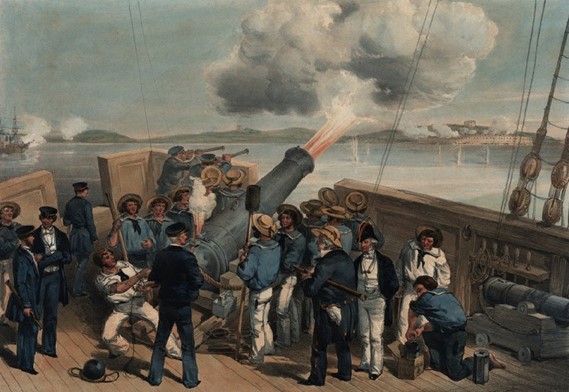
The Bombardment of Bomarsund -Lithograph by Edwin T. Dolby (1838-1900)
Overall, it was a well conducted operation with the Allies accomplishing their objective with few casualties. Smith’s memory of the length of the operations was not quite accurate. He was probably not closely involved in the attack. As one of Napier’s newer ships, the St. Jean d’Acre was employed as one the blockading squadron (much to Captain Keppel’s disgust[2]). While marines and naval guns and crews were landed from British ships, Keppel’s account does not mention any coming from his ship.
Smith’s ship returned to Britain to refit before proceeding to the Black Sea. According to Smith’s recollections, on the voyage out, the St. Jean d’Acre called at Queenstown in Ireland to collect troops for transport out to join the Allied armies in the Crimea. He records that the troops arrived in time to take part in the battle of Balaklava. Again, his memory seems likely to have let him down. The battle was fought on 25 October 1854 and his ship did not arrive in the Black Sea until 1855.[3]
The French and British armies had landed on the Crimea peninsula in September 1854 with the object of capturing the primary Russian naval base on the Black Sea, Sebastopol. The campaign was not well managed. While the Allies closed off the southern landward approaches to Sebastopol, the Russians were still able to bring in reinforcements and supplies by water from the north and later across a floating bridge. In May 1855 the Allies sent a large naval squadron and transports carrying troops into the Sea of Azov with a view to disrupting supply routes to Sebastopol. Smith and his ship were part of this operation and he was present at the capture of Kerch. This move by the Allies proved to be a crucial step in the siege of Sebastopol. Smith remembered “we were bombarding Sebastopol when it was blown up one Sunday.” The Russians blew up the fortress’s magazines on Sunday 9 September 1855 and abandoned the city. The siege had lasted 11 months.
On 17 October an Allied fleet attacked and destroyed Russian fortifications at Kinburn as part of a wider operation at the mouth of the Dnieper River. Once again Smith and the St. Jean d’Acre were involved. The most interesting feature of the engagement was the first use of ironclad warships. Three French ironclads carried out the main destructive work. They were able to approach the forts much more closely than the wooden walled warships and despite being hit repeatedly by Russian gunfire were able to complete their task with very few casualties and little structural damage.
Soon thereafter the Russians sued for peace and the war was formally ended by the Treaty of Paris in March 1856. Smith received a bar to his Crimean War medal for his participation in Black Sea naval operations.
Smith spent about 12 months in the Black Sea in total before returning to Portsmouth. Once home “…we prepared the ship for Earl Granville, Sir Robert Peel and party to go to St Petersburg. Our ship would not go further than Kronstadt and I was one of fifteen selected to go on the state barge, which was towed up by a little steam boat as far as St Petersburg, where we stayed for eight days”. Smith (or the newspaper’s reporter) does not explain the reason for this visit. The St. Jean d’Acre took the British party to the coronation of Tsar Alexander II in September 1856. The ship returned to Britain via Kiel (then in Denmark) and paid off in Plymouth.
Smith served for three years and four months on the St. Jean d’Acre but did not stay in the Royal Navy after his ship paid off. He appears to have acquired a taste for foreign parts as he then travelled out to Buenos Aires and spent 18 years sheep farming in Argentina. On his return to Milford Haven, he found that his mother has lost both his medals and his discharge papers.
Smith was admitted to Haverfordwest workhouse from Steynton parish on 20 July 1898 as he was destitute.[4] He had been there seven weeks when he met with the newspaper reporter. Smith discharged himself on 1 November 1898 but was readmitted, again destitute, less than three weeks later. This time he stayed for a considerable period, only discharging himself on 21 August 1899. The workhouse death register records that he died on 21 January 1902 and was buried in Milford Cemetery.[5]
Peter Jones was the son of a ship’s carpenter and was born in Waterston, Llanstadwell in 1835.[6] He was living in Cardiff when the war broke out and enlisted in the Scots Fusilier Guards (today the Scots Guards).[7] His services papers show that he join the regiment on 26 September 1854, giving his age as 18 and place of birth as Llangwm.[8]
Jones joined his regiment in the Crimea and participated in the siege of Sebastopol. The siege techniques of the day required a zigzagging line of trenches to be dug to allow the besieging forces to approach close to the fortifications under some cover from the defenders’ fire. Once the trenches were close enough and the besiegers’ artillery had breached the defences, the infantry would move forward through the trench system and rush across the (hopefully narrow) strip of ground to storm the fortifications. While deployed in the trenches, Jones and his comrades came under heavy Russian artillery fire and a shell exploded hitting him in the left knee, killing a colleague and severely wounding another. His leg was amputated and he wore an artificial limb thereafter. In hospital, Jones says he suffered excruciating pain. There was, however, “…some little compensation, for each man in hospital received a pint and a half of porter a day and improved rations”. He also recalled “with amused pleasure how he and others, by certain devices, managed to secure an extra allowance of porter daily from the kind-hearted surgeon”. Jones was lucky to survive. The death rate for amputations at the thigh was 63% in the Crimea.[9] He may have been fortunate to have been wounded later in the conflict, as medical services had begun to improve by then from the well-known nadir of the early stages of the war. Jones was awarded the Crimea Medal and also received a medal from the Turkish government. He was discharged from the army on 11 March 1856. His invalidity entitled him to a pension of 1s a day.
Jones’s service papers note that on discharge he was intending to “reside at Swansea”. However, he soon returned to his native Pembrokeshire. On 17 April 1859 Jones married a widow, Mary Pugh of Shut Street (otherwise Dew Street), at St Mary’s, Haverfordwest.[10] The 1871 census shows Jones and his wife living in Shut Street with his step son and their daughter (Mary Ann, born 1860). His wife appears to have been about 16 years older than Jones and by the time of the next census he was a widower living as a boarder in Dew Street. He lived in Dew Street from 1859 until his death, latterly at number 64 on which he held a lease for life or until 25 March 1921 at a ground rent of £9 p.a. (he also held the lease on number 66, the adjacent house).[11]
In 1883 he married again. This time the age difference was reversed as his second wife, Margaret (Mathias), was some 16 years his junior. The couple went on to have a son (Benjamin, born 1886) and three daughters, Martha Jane (1883), Hannah Elizabeth (1888) and Alice (1892).[12] Their son and eldest daughter predeceased their parents.[13]
Although Jones gave his occupation as a variation on army pensioner on each census return, he worked as sexton of St Mary’s church, Haverfordwest. He held the post from at least 1884[14] until he retired in April 1908.[15] His second wife worked as a dressmaker, which would have bolstered their income as would an increase in his army pension by 3s 6d a week just after the turn of the century. The introduction of old age pensions in 1909 further increased his income. Jones did not receive the full 5s per week because of the income limit that applied; he did, however, get an extra 2s a week. For many years Jones was also the organ blower at St Mary’s Church. After his retirement as sexton, he appears to have started to attend Albany Chapel rather than the church. He performed the same organ blower’s service at the Albany Chapel.
Although a stalwart of church and later chapel, Jones was surprisingly familiar with the Haverfordwest Petty Sessions. In June 1864 his neighbour, Thomas Morgan was charged with threatening a breach of the peace against Jones. At the same time, his wife Mary was charged with assaulting another neighbour, William Beynon. The magistrates heard the two cases together as both stemmed from an argument between Mary Jones and William Beynon and the theft of some gooseberries from the latter’s garden. The justices dismissed both cases and admonished all concerned for failing to live peaceably together. Jones had to pay costs of 6s 6d and Beynon costs of 10s 6d. Part of the argument seems to have stemmed from a dispute as to the relative merits of Jones’s (short) Crimea service and Morgan’s (much longer) service in India. In October 1873, Jones argued with another neighbour, Eliza Morse, and was knocked down. Morse was convicted of assault and fined 2s 6d plus costs. The School Board took Jones before the magistrates in May 1893 for failing to send his daughter Martha Jane to school (this may be the second similar offence). He was fined 1s.[16]
His wife Margaret died on 11 November 1916 aged 63. The following year he placed an “In memoriam” in a local paper, including a short poetry quotation, suggesting he was much attached to his second wife.
Jones evidently became a well-respected character in Haverfordwest as when he was confined to bed following a fall coming out of Albany Chapel in January 1917, it was news considered worthy of reporting in the local paper.
Peter Jones died on the morning of Thursday 18 September 1919. He was buried in St Mary’s Cemetery on the following Sunday with military honours. A firing party from the King’s Own Yorkshire Light Infantry fired three volleys over his grave and a bugler played Last Post.
Thomas Owen Phillips was born in 1825[17]. His obituary described his father, James, as being of Crows’ Nest Farm, Haverfordwest.[18] By the time of his birth however, his father’s occupation was innkeeper and his place of residence Prendergast.[19] Phillips worked as a cabinet maker before joining the army in 1848.[20] He enlisted in the Scots Fusilier Guards on 3 December 1848, receiving a £4 bounty for doing so. The next day he had a medical examination and then attested before a magistrate in Haverfordwest. He signed on for 10 years. After attesting, he was given 15s and then departed for the regimental depot in London. On 19 December he was given a further medical examination by the regimental surgeon. He is described as being 5 feet 8½ inches tall, of dark complexion, with hazel eyes and black hair. He had a tattoo on his left forearm. (In his obituary, he was described as being the shortest man in his regiment at 5 feet 10 inches tall, showing how tales grow in the telling.)
Phillips and Jones were not the only Pembrokeshire men to serve in the Scots Fusilier Guards at this time. Although the regiment did not have a particularly Scots character then, it does raise an interesting question as to the connections that brought this about.
Phillips had a reputation as a crack shot and claimed to have only missed winning the army prize as best marksman by one point. His discharge record describes his conduct “as rather irregular during his service in England but on [active] service it has been that of a good and efficient soldier”.
The Scots Fusilier Guards were amongst the first British soldiers sent to the Crimea and were part of the Guards Brigade serving in the 1st Division under the Duke of Cambridge, Queen Victoria’s cousin.
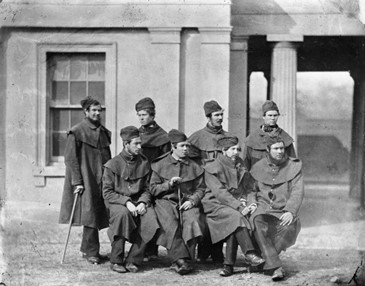
Scots Fusilier Guards convalescing
– Joseph Cundall and Robert Howlett
After the Allied landings, the Russian forces made an attempt to stop the advance on Sebastopol. This resulted in the battle of Alma on 20 September 1854. The Allied forces had landed north of Sebastopol and were advancing southwards with the French troops nearest the coast and the British on the landward flank. The Allied commanders agreed to make simultaneous assaults on the Russian positions on the heights above the river Alma. However, the British commander, Lord Raglan, decided to delay his attacks until after the French had made their attacks. The French succeeded in turning the Russians seaward flank by scaling steep cliffs that were poorly defended. Pressed by his subordinates, Raglan then joined the assault. The British troops drove the Russians from the heights but not after some considerable confusion. The superior accuracy and range of the rifles carried by the British and French infantry played an important role in securing victory. The Russian forces were still using old style smoothbore muskets in the main.
Queen Victoria was alleged to have a partiality for the Scots Fusilier Guards which caused resentment in the Guards Brigade. When “…the regiment fell back in some disorder at the Alma as a result of a misunderstood order, the Grenadiers and Coldstream, coming on steadily through the fire, chorused “Shame! Shame! What about the queen’s favourites now?” ”[21]
On 30th September 1854, John Moore, another soldier in the Scots Fusilier Guards, wrote to his mother in Haverfordwest from the hospital at Scutari. He had been wounded at Alma but was “happy to inform you that I am as well as can be expected in the circumstances”. He wrote that “it was a very hot engagement indeed while it lasted, which was not long”. Moore wrote that “my comrade Thomas Phillips, of the Bull Inn, is wounded in the leg, but he is doing well”. Moore also passed on news of two other local lads, Tom Owens of Shut Street who was severely wounded and William Griffiths who had come through unscathed.[22]
Phillips received a gunshot wound through the right leg during the battle. It caused a compound fracture of one of the bones in his lower leg. His discharge papers describe the wound as severe, but he both kept his leg and survived despite the dire quality of the British army’s medical services in the Crimea. He returned to England and was discharged in London as unfit for further service on 26 July 1856. He would have been granted a pension of 1s a day.
He soon returned to Haverfordwest and on 21 September 1856 he married a widow, Mary Ann Jenkins, in Prendergast church. His marriage record shows he returned to his pre-army days profession as a journeyman joiner. However, this was short lived, as before the year was out, he had become the landlord of the Ivorite Arms on Old Bridge Street in Haverforwest.[23] This occupation ran in the family as his father was landlord of The Bull in Prendergast. His obituary noted that he served as a supernumerary sergeant in the militia after his discharge but I have been unable to confirm this.
Phillips and his wife had six children: Mary Ann (born 1858), Thomas (1859), Ellen (1861), Alice (1864), William (1867) and Edith (1872).
In 1868 the Ivorite Arms closed and the building was converted into a private dwelling. Phillips moved to a house near Cartlett Kilns. In October 1868 he applied to the magistrates for licence so he could continue his business from his new home.[24] His application was granted and he named his new pub the Ivorite Arms! That his application was granted tells us something of the standards expected of publicans in mid-Victorian Haverforwest. Phillips had been fine £1 in 1866 for a number of offences including drunkenness, riotous conduct and refusing to allow a police officer to enter a pub.[25] In January 1868 he had been charged with illegal salmon fishing in the Western Cleddau. Although the case was dismissed, the magistrates remarked that the “Bench were not at all satisfied that the defendant was not guilty, but in the present state of things, they did not feel the evidence sufficient to convict”.[26] These were not his first brushes with the authorities, nor his last. In December 1850, while in the army, he was “…apprehended by the civil power for wilful and malicious damage of glass…” and spent a month in gaol.[27] In May 1873, he was charged with selling beer outside opening hours on a Sunday. He escaped conviction by claiming to have been in church. The illegal use of sugar in brewing beer saw him fined £2 10s in 1881.[28]
In 1902, Phillips applied to the Royal Hospital Chelsea for an increase in his pension. His application included a report from a local surgeon to the effect that a deterioration in his condition now prevented him from working. He was granted an increased pension of 18d per day.[29] Phillips died on Sunday 15 November 1908 and was buried in Prendergast.[30]
James Lewis was another native of Llangwm.[31] He was born in 1834 and joined the Royal Navy in 1850, serving for 26 years. On the outbreak of the Crimean War, Lewis was serving in HMS Highflyer in the Mediterranean Fleet. The Highflyer was a 21-gun wooden steam corvette. His ship served in the Black Sea throughout the war. Lewis recollected “the horrible sufferings of all the crew owing to the shocking state of the food”. The Highflyer was involved in the bombardment of Sebastopol. Lewis received the Crimea Medal with a clasp for Sebastopol and also a medal from the Turkish government.
Lewis went on to serve in a number of Pembroke Dock built ships: HMS Brunswick (an 80-gun wooden steam line of battle ship), HMS Duke of Wellington (a 131-gun wooden screw line of battle ship) and the royal yacht. (The Duke of Wellington was briefly the most powerful warship afloat. She was launched as the Windsor Castle of 14 September 1852 but was soon renamed after the duke who died on the day she was launched.) Lewis’s service on the royal yacht included a visit to St Petersburg in 1874 for the marriage of Queen Victoria’s son, Prince Alfred, Duke of Edinburgh, to Grand Duchess Marie Alexandrovna, the daughter of Tsar Alexander II.
Lewis also served on HMS Serapis, a troop transport used to carry soldiers to and from India. In 1875-6, the Serapis conveyed Edward, Prince of Wales, to India for a tour that included celebrations that marked Queen Victoria assuming the title Empress of India. This voyage was probably Lewis’s last with the Royal Navy. After leaving the navy, he worked in the dockyard at Pembroke Dock for a short time, then in the marine service at Neyland before becoming a Llangwm fisherman.
When interviewed by a local newspaper reporter in 1916, Lewis was “hale and hearty”, visiting the military camp at Hearston daily for the latest war news. Being familiar with the Dardenelles from his navy days, he saw the Allies’ efforts at Gallipoli as “…foredoomed to failure in the absence of co-operation by adequate land forces”. He was optimistic that the war would end that year and “only hopeful that his prediction will not be falsified by events” (as it indeed would be). Lewis and his wife had been married for 52 years at the time of the newspaper interview. He noted that one of their two sons was working in San Francisco. That son, James, also had a connection to the maritime world. He worked as foreman of shipwrights for the South Western Shipbuilding Company of San Pedro, California, which was established to build cargo ships for the Emergency Fleet Corporation of the US Shipping Board during the First World War.[32]
For Peter Jones his short service in the army during the Crimean War seems to have been the pivotal event of his life. For the others, the war was an important episode without being quite so central. All four were proud of their wartime service which earned them (perhaps belatedly) recognition from the local community.
NOTES
1 Much of Smith’s life story comes from a report in the Haverfordwest and Milford Haven Telegraph and General Weekly Reporter for the Counties of Pembroke, Cardigan, Carmarthen, Glamorgan and the Rest of South Wales of 14 September 1898.
2 Keppel wrote a report on this operation in Jean D’Acre’s log book and this provides much of the detail on the operations in which Smith participated. See A D Lambert, Naval Records Society, volume 125.
3 The Russian War 1855 Black Sea, A C Dewar, Naval Records Society, volume 85.
4 Haverfordwest Workhouse Book of Admissions and Discharges, SPU/HA/2, Pembrokeshire Archives.
5 Haverfordwest Workhouse Death Register, SPU/HA/3, Pembrokeshire Archives. Smith may have been readmitted, and discharged, and again readmitted between 1899 and 1902. There appear to be two (or possibly three) Thomas Smiths of very similar age who were in and out of the workhouse over this period.
6 Jones was baptised on 10 May 1835. See Parish Registers, Pembrokeshire Archives.
7 Reports in the Haverfordwest and Milford Haven Telegraph, 10 February 1909 and 24 September 1919 provide much of Jones’s life story.
8 Scots Guards Service Records 1799-1939 accessed via findmypast.co.uk. His regimental number was 4923.
9 Redcoat, Richard Holmes, London, 2001.
10 St Mary’s Haverfordwest Parish Registers, HPR-2, Pembrokeshire Archives.
11 See sales particulars in Pembrokeshire Herald and General Advertiser of 8 June 1888 and 25 October 1907.
12 St Mary’s Haverfordwest Parish Registers, HPR-2, Pembrokeshire Archives and Fenton School Attendance Records accessed via findmypast.co.uk
13 1911 Census return.
14 See baptism record for his daughter Martha Jane.
15 Pembroke County Guardian and Cardigan Reporter, 24 April 1908.
16 Pembrokeshire Herald General Advertiser, 10 June 1864 and 24 October 1873; Haverfordwest and Milford Haven Telegraph, 3 May 1893.
17 His obituary, his baptism record and his army service record do not agree on his year of birth, giving or implying 1826, 1825 and 1827 respectively.
18 Pembrokeshire Herald and General Advertiser, 20 November 1908.
19 Prendergast Parish Registers, HPR-71, Pembrokeshire Archives
20 Scots Guards Service Records 1799-1939 accessed via findmypast.co.uk. His regimental number was 3791
21 Redcoat, Richard Holmes, London, 2001
22 Pembrokeshire Herald General Advertiser, 13 October 1854.
23 The Pubs of Haverfordwest, Milford Haven and Mid-West Pembrokeshire, Keith Johnson, 2006.
24 Pembrokeshire Herald and General Advertiser, 16 October 1868.
25 The Pubs of Haverfordwest, Milford Haven and Mid-West Pembrokeshire, Keith Johnson, 2006.
26 Pembrokeshire Herald and General Advertiser, 24 January 1868.
27 Scots Guards Service Records 1799-1939 accessed via findmypast.co.uk. His regimental number was 3791.
28 Pembrokeshire Herald and General Advertiser, 23 May 1873 and 23 December 1881.
29 Scots Guards Service Records 1799-1939 accessed via findmypast.co.uk. His regimental number was 3791.
30 Prendergast Parish Registers, HPR-71, Pembrokeshire Archives.
31 Much of Lewis’s life story comes from a report in the Haverfordwest and Milford Haven Telegraph and General Weekly Reporter for the Counties of Pembroke, Cardigan, Carmarthen, Glamorgan and the Rest of South Wales of 6 September 1916.
32 Haverfordwest and Milford Haven Telegraph and General Weekly Reporter for the Counties of Pembroke, Cardigan, Carmarthen, Glamorgan and the Rest of South Wales of 1 January 1919. See shipbuildinghistory.com