

During several periods of English and Welsh history the national government was either unwilling or unable to provide the means of exchange, coinage of small denominations to enable the population to conduct everyday transactions. The Crown had issued monopolies which authorized certain noblemen to issue copper farthings during the reign of James I and Charles I (Harington, Lennox, and Richmond) but these had been ended by Parliament during the tumult of the civil wars (1642-48). Although tokens issued by cities like Bristol had circulated since the reign of Elizabeth I (with official acquiescence rather than approval), the pennies, halfpennies and farthings which appeared across England, Wales, and Ireland from 1648 were on an unprecedented scale. They met a very palpable need.
Struck in brass or copper the tokens usually carried the name of the merchant who issued them, a date and place of issue. They were conventionally round although from 1668 they appeared in an intriguing variety of shapes including hearts, lozenges, and squares. If a merchant was a member of a certain trade guild their coat of arms would usually appear on the obverse. Around 15,000 seventeenth-century tokens are known to have been issued although the number increases as new issuers become known. An astonishing variety of trades and occupations are represented in this first great national token epoch including mercers, grocers, tallow chandlers, glovers, coopers, haberdashers, innkeepers, and a vast number of others besides. They were unlicensed and unofficial but the Commonwealth and the government of Charles II tolerated them.
These tokens tell us a great deal about society and the economy before the industrial revolution. The number of tokens from a particular town are reflective of that community’s size and population. Thus, London has at least 4,000 tokens with regular new discoveries. Wales has 130 tokens although Cardiganshire (now Ceredigion) is the only county in England and Wales with no known token issuers. Only one Welsh borough, Brecon, brought forth municipal tokens in 1670 while all the other Welsh examples came from merchants and tradesmen.
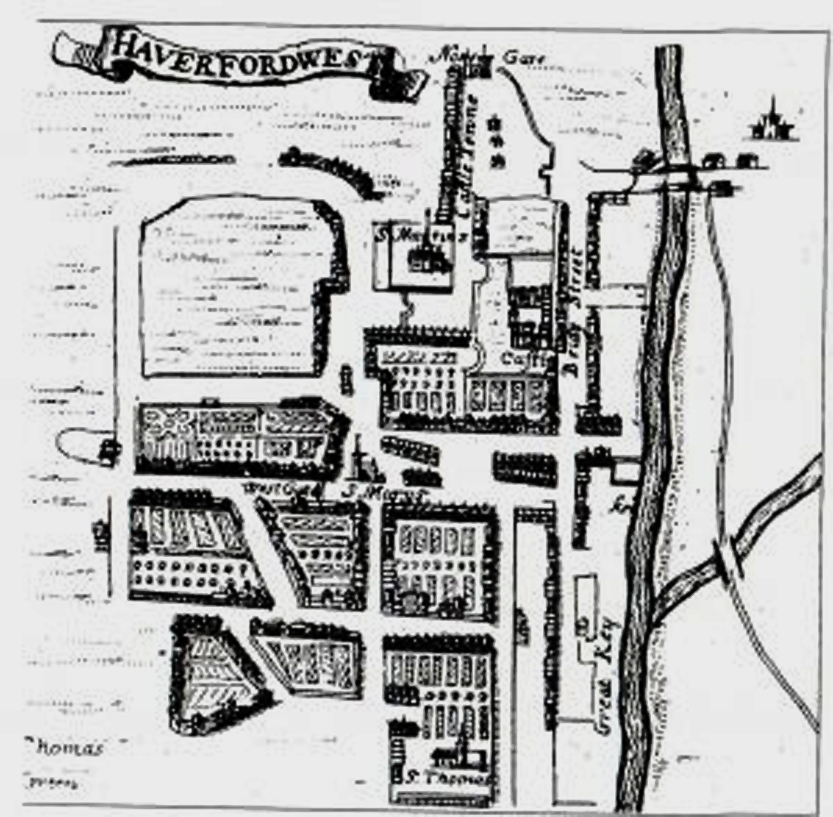
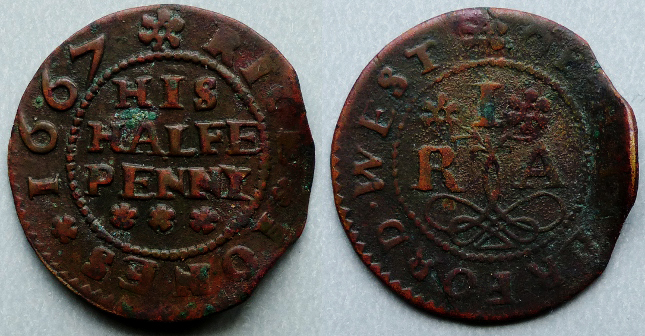
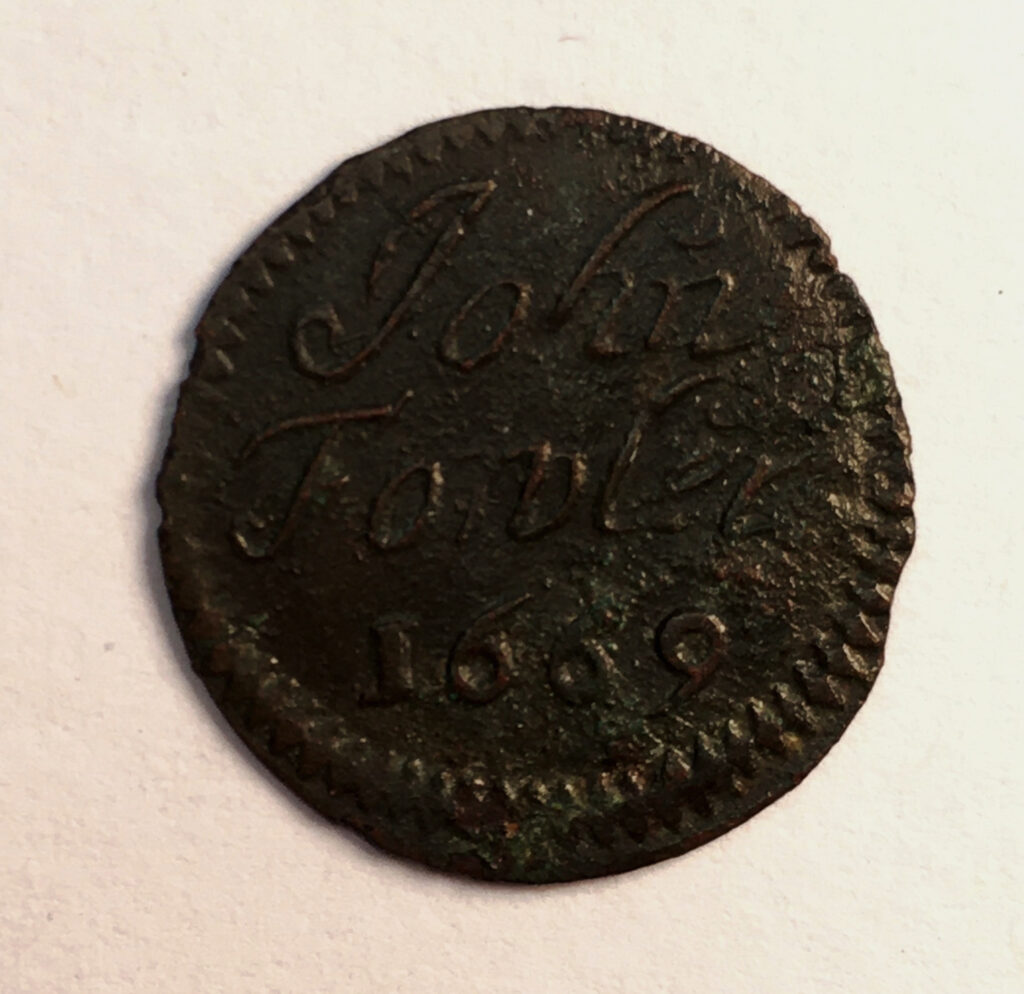
Pembrokeshire has seventeen known tokens from this period, the earliest dated ones come from 1666, towards the end of the period. Haverfordwest has twelve tokens, the most of any town in Wales, tying with Wrexham which has the same number. Haverfordwest has far more than Swansea or any of the ports and towns which expanded over the following century due to the coal, iron, and copper industries. The dominant traders in Haverfordwest according to tokens issued were mercers who sold cloth, ribbons, buckles, buttons, and the like. The traders included William Bateman (an early Quaker), Henry Bowen, Edward Lord and Zachary Phillips. The latter was completely unknown until July 1998 when the only known example was found in Haverfordwest. Exhaustive research has failed to identify any biographical information about this man. Another mercer was Jane Sparke, the only woman in the Pembrokeshire series and one of only three female issues across the whole of Wales. Jane was probably the daughter of William Sparke of Prendergast. Other Haverfordwest issuers were Thomas Tasker and Thomas Wilkin whose tokens featured the design of a ship coming out of a castle remarkably similar to the design of the Bristol city tokens. Rice Jones issued a brass halfpenny with an interesting floral knot design while John Fowler (mayor in 1685) has his signature stamped in brass on the obverse of his token. The drapers’ arms appear on the token of Thomas Bowen and a hare on the token of Jacob Wolford, a glover. The coat of arms of the Boulton family appears on the front of the token of Thomas Boulton, a very enigmatic figure yet to be positively identified. There was a strong correlation between the token issuers and the common council. A number occupied the posts of sheriff and mayor.
Other Pembrokeshire towns had far fewer tokens indicating their smaller population and trading class. Pembroke surprisingly has only one token, a copper halfpenny by John Hinton which appeared in 1669. He was mayor of the borough in 1667-8. Narberth also has one known issue, the farthing of Mallet Bateman from 1667 with a bird design and the name of the community charmingly spelt as ‘NORBERTH.’ Mallet Bateman, an affluent merchant and shopkeeper died in 1699. The prosperous town of Tenby has three known token issuers. John Sayes and Walter Henborough were both mercers. The former has a fine memorial brass in St. Mary’s Church recording his death in 1693 at the age of seventy. Four times mayor, Devereux Hammond is known by just two surviving examples. The survival rates for base metal tokens were probably very poor hence many are known from one, two or three examples.
An official issue of pennies, halfpennies, and farthings in 1672 was sufficient to meet the needs of the population and a royal proclamation in August 1672 forbade the use of these private tokens. Those holding them found their value had disappeared and they were melted down or merely thrown away. Today the series is seen as a microcosm of society 350 years ago and numismatists and local historians esteem them highly, just as the diarist John Evelyn predicted in 1697. Consequently, their monetary value has risen appreciably although their real value is one which cannot be truly expressed in monetary terms.